
B2B Marketing for Small Business The 2026 Playbook to Generate Consistent Leads
This article is a practical, research‑backed roadmap for B2B marketing tailored to small and mid‑sized businesses in 2026. It explains why many SMB websites fai…


Introduction: Why B2B Marketing Is the Lifeline for Growing SMBs
Does your website feel more like a digital business card than a sales machine? You are not alone. Many small and mid-sized business owners pour money into a beautiful site, only to watch it sit there like a pretty brochure. Visitors come, glance around, and leave. No calls. No forms. No sales.
That is the real challenge of B2B marketing in 2026. Customer acquisition is harder than ever. Competitors are everywhere. And your potential buyers are smarter, busier, and more distracted than ever before.
The problem is not your product. And it is not your team. The problem is that most SMB websites were built to look good, not to generate leads. They lack the strategy, the content, and the conversion paths that turn a casual browser into a paying client.
But here is the good news. You can fix this. And you do not need a giant budget or a big agency to do it.
This guide is your research-backed roadmap to B2B marketing success. We will walk through the strategies that actually work for growing businesses in 2026. We will show you how to evaluate a B2B digital marketing agency before you sign a contract. And we will help you measure what matters so you stop guessing and start growing.
Along the way, we will cover approaches like account based marketing for B2B, which helps you focus your energy on the high-value prospects most likely to buy. Whether you are just starting out or ready to upgrade an existing team, this roadmap gives you a clear path forward.
Understanding where to invest your money is the first step. Most B2B companies land somewhere between 7.7% and 8% of revenue on marketing, with that number shifting based on growth stage and industry, according to B2B marketing budget benchmarks for 2026. Knowing that range helps you stop wondering if you are spending too little or too much.
If you are ready to turn your website into a real lead generation engine, start by building a clear internet marketing strategy for small business. That foundation will make every tactic in this guide work harder for you.
And if you want consistent traffic without the headache of managing everything yourself, you can Grow Your Traffic on Autopilot by connecting your website with Weblish.
But first, let us look at the biggest mistake most SMBs make with their B2B marketing and how to avoid it.
What Is B2B Marketing and Why Should SMBs Care?
B2B marketing sounds fancy, but it is simple. It means marketing your product or service to other businesses instead of to individual shoppers. If you sell software to HR departments, accounting services to law firms, or parts to manufacturers, you are doing B2B marketing.
The difference from B2C is huge. When you sell to a business, you are not trying to convince one person. You are trying to convince a whole group: the budget owner, the technical buyer, the end user, and sometimes the CEO. That group researches together, compares options, and takes months to decide. A B2C buyer might pick a new pair of shoes in minutes. A B2B buyer will spend weeks evaluating your software.
This long sales cycle is why many SMBs struggle. You have a small team and a tight budget, yet you need to stay top of mind for months before a prospect signs. And you are competing with bigger companies that have entire marketing departments.
Here is a number that might shock you. Small business marketing budget statistics for 2026 show that 66.3% of small business owners spend less than $1,000 per year on marketing. That is hardly enough to run a single LinkedIn ad campaign. No wonder many SMB websites collect dust.
So how do you build a B2B marketing foundation when your budget is tiny? You focus on three things.
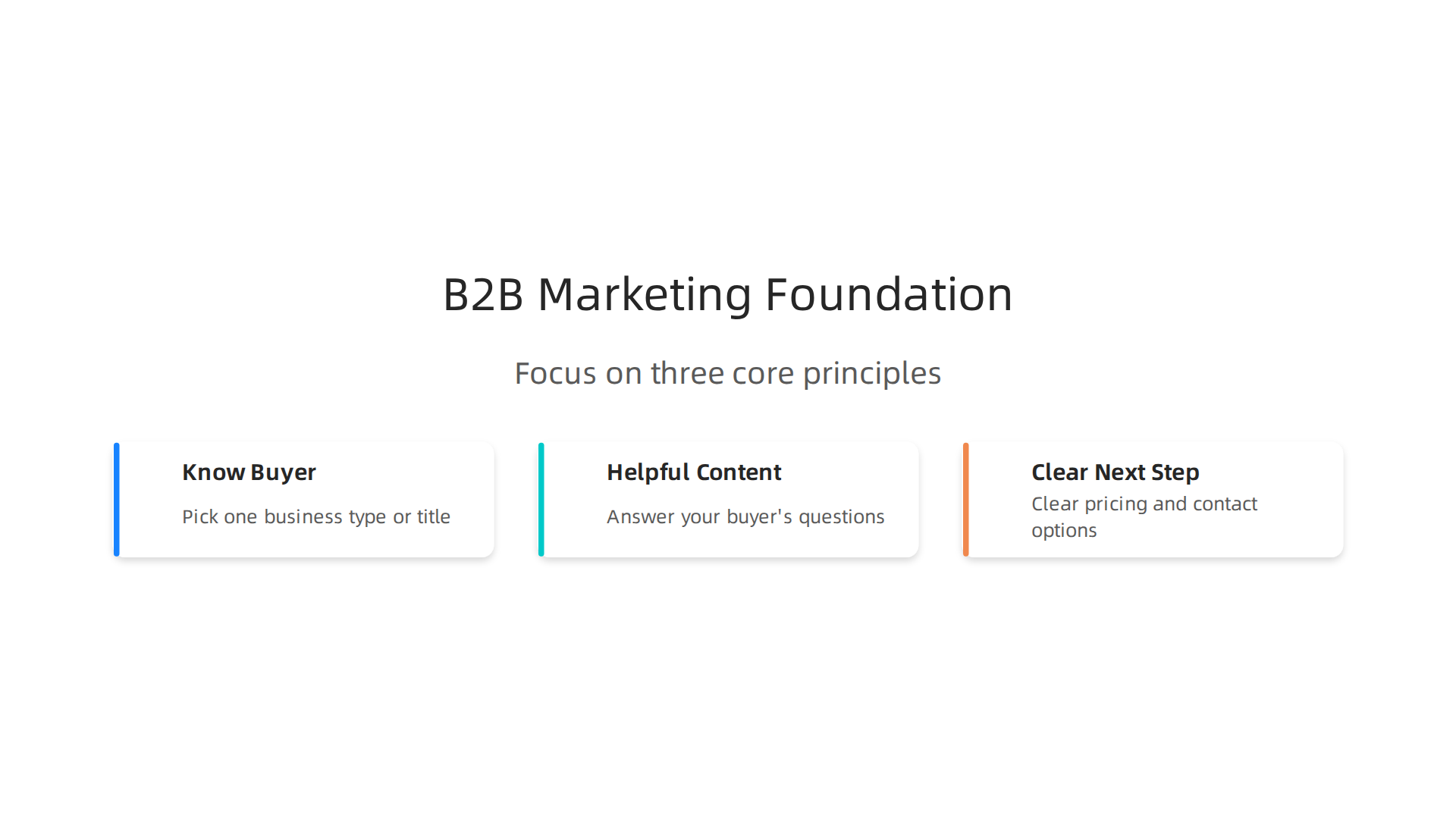
First, know exactly who you sell to. Do not try to sell to everyone. Pick one type of business, one job title, one problem you solve better than anyone else. That focus makes your message stronger and your marketing cheaper.
Second, create content that answers your buyer’s questions. Write blog posts, record short videos, or share case studies that show how you solved a real problem. When a prospect finds your helpful content, they start trusting you before you ever talk.
Third, make it easy for them to take the next step. Put clear pricing on your site if you can. Add a simple contact form. Offer a free consultation or a downloadable guide. Remove every friction point.
This is where marketing vs advertising the simple framework smbs are missing comes in. Many business owners confuse advertising with marketing. Advertising is one piece of marketing, but real marketing is the whole system: your website, your content, your email list, your reputation. Building that system does not require a huge budget. It requires a clear plan and consistency.
Start small. Pick one channel where your ideal buyers hang out. LinkedIn works for many B2B companies. Industry forums or niche Facebook groups work too. Publish one helpful post each week. Answer questions. Share your expertise. Over time, that small effort builds a steady stream of leads.
You do not need a six-figure marketing budget to begin. You just need to start with the right foundation.
The 5 Most Effective B2B Marketing Strategies for 2026
Once your foundation is solid, you need a specific game plan. You cannot do everything at once, especially with a small budget. So focus on the strategies that deliver the biggest return for the smallest investment.
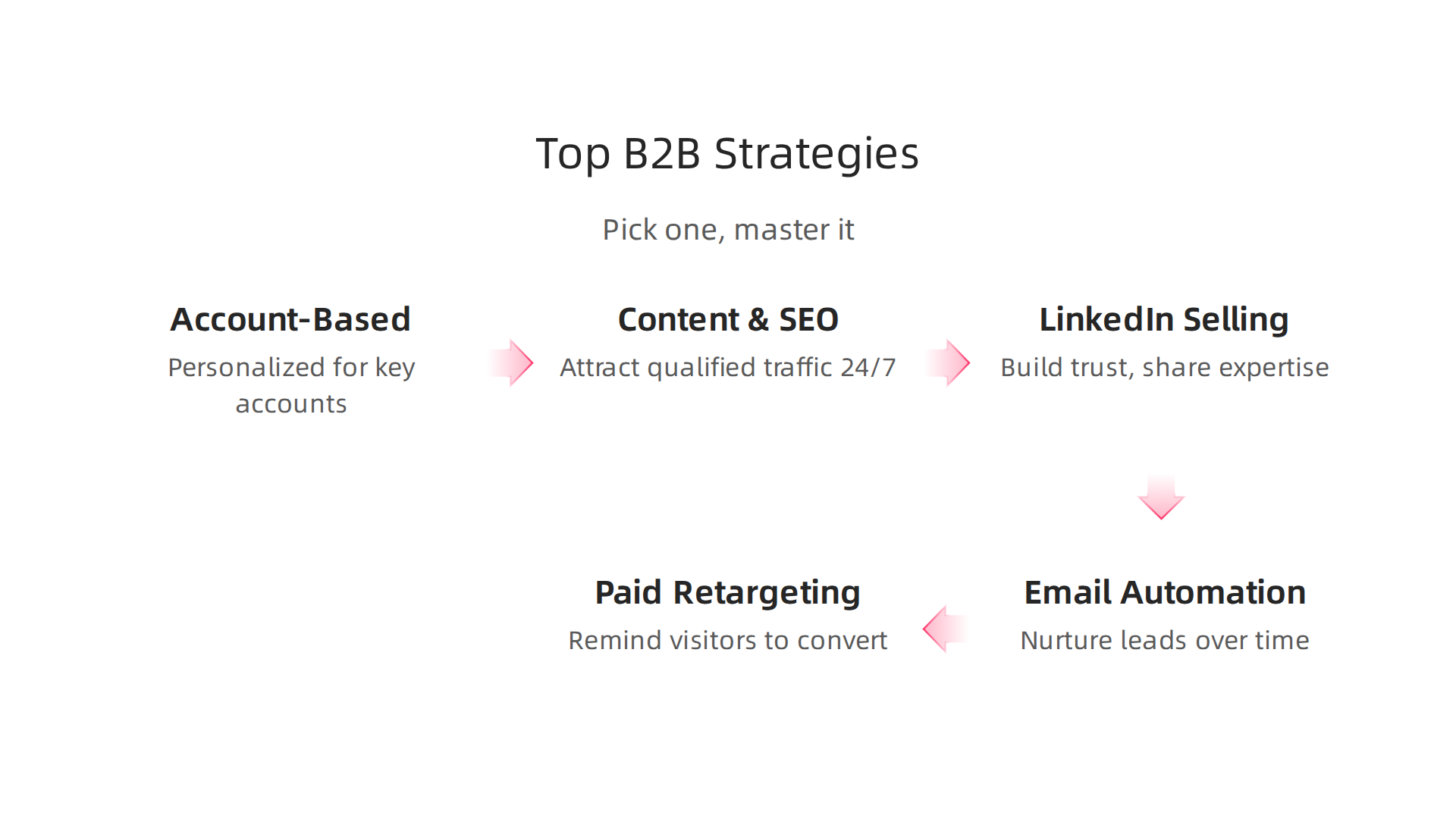
Here are the five most effective B2B marketing strategies for 2026. Pick one, master it, and then add the next.

1. Account-Based Marketing (ABM)
Stop trying to sell to everyone. Instead, pick your 20 most wanted accounts and treat them like royalty. This is called account-based marketing for B2B. You research each company, find the decision-makers, and create personalized content just for them. A salesperson might send a custom video. Marketing might run a tiny LinkedIn ad campaign targeted only at those 20 companies. It feels personal because it is personal. ABM works incredibly well when you have a high ticket offer because the effort you put in matches the size of the deal.
2. Content Marketing and SEO
Your website should work for you 24 hours a day, 7 days a week. That only happens when you create content your buyers are actually searching for. Write a blog post that answers the exact question your prospect types into Google at 2 PM on a Tuesday. Optimize it for search engines so it shows up on page one. Over time, this consistent effort brings a steady stream of qualified traffic without paying for ads. Most B2B marketers rank content marketing as their single highest ROI channel. If you want to do this well, start with these simple SEO content optimization strategies.
3. LinkedIn and Social Selling
LinkedIn is the new storefront for B2B. You do not need to run ads. You just need to show up and share your expertise. Post a short tip every day. Comment on your prospects’ posts. Answer questions in industry groups. This builds trust slowly over time. When that prospect is finally ready to buy, they will remember your name. Social selling feels slow at first, but the trust it builds is hard for competitors to copy.
4. Email Automation and Nurturing
Most of your leads are not ready to buy today. They might need three months to get budget approval. Email automation keeps you top of mind during that waiting period. Set up a simple five-email sequence that delivers value. Send a case study. Share a checklist. Offer a free consultation. Do not just pitch your product. Email marketing continues to offer one of the highest ROIs in the industry. According to recent B2B marketing statistics for 2026, email returns $36 for every $1 spent when done right.
5. Paid Media with Retargeting
If you have a small advertising budget, do not waste it on cold traffic. Spend it on retargeting. Retargeting shows ads only to people who have already visited your website. They already know you exist. Your ad simply reminds them to come back and take the next step. This is the highest ROI paid strategy for small budgets. You can run a retargeting campaign on Google or LinkedIn for as little as a few hundred dollars a month.
You do not need to run all five strategies next week. Pick the one that fits your business best and go deep. If you want help executing this playbook without hiring a full b2b digital marketing agency, you can Grow Your Traffic on Autopilot by connecting your site with a dedicated growth team that handles the execution for you.
How to Select a B2B Marketing Agency That Delivers ROI
Maybe you read the strategies above and thought, "That sounds great, but I don’t have the time or the team to execute it myself." That is completely normal. Many small business owners reach a point where they need to bring in outside help. But hiring the wrong agency can waste your budget and slow you down.
So how do you pick a B2B marketing agency that actually delivers results? You need a clear process. Let’s break it down.
What to Look for in a B2B Marketing Agency
Not all agencies are created equal. The ones worth your money share three things in common.
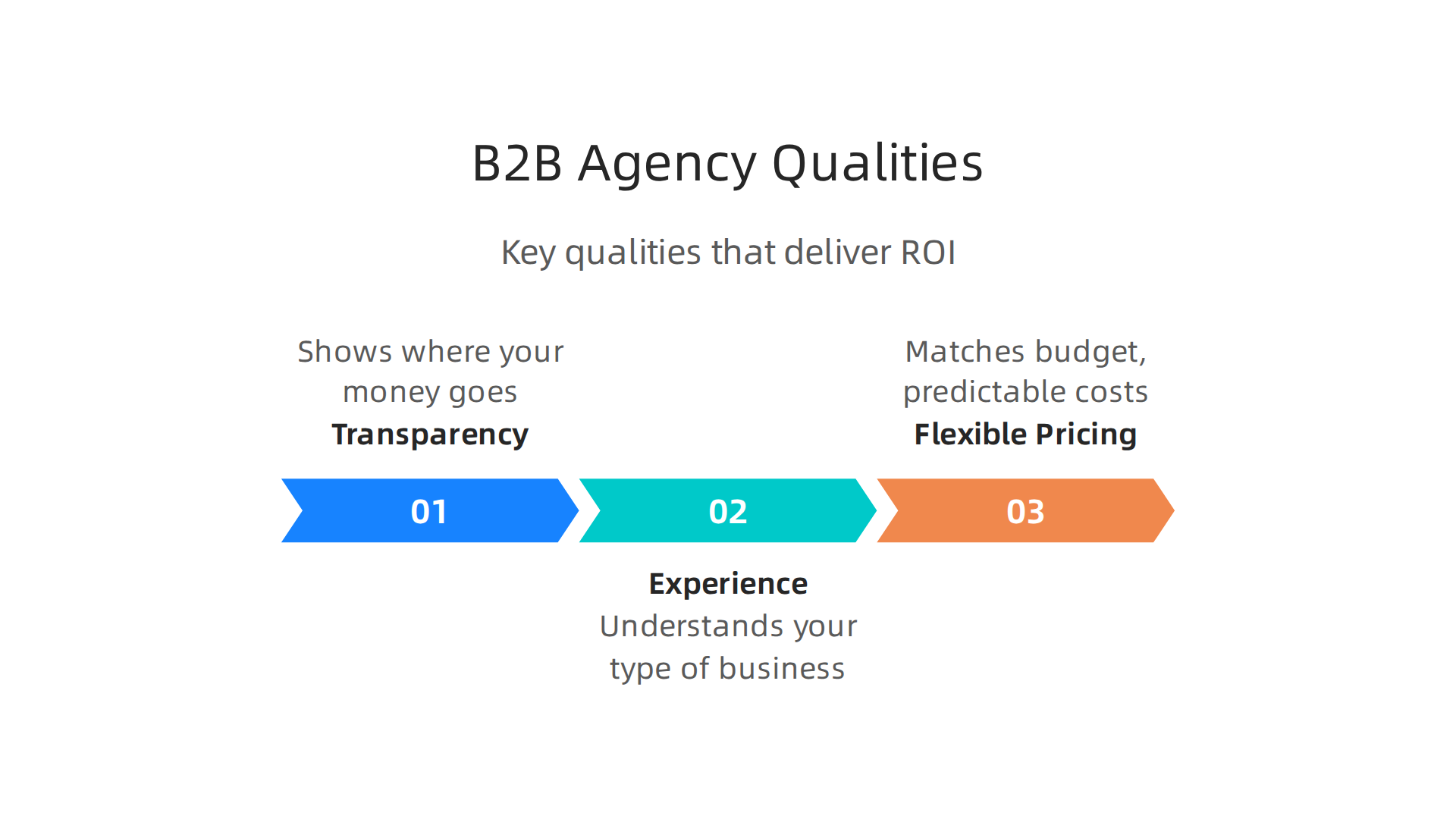
Transparency. A good agency shows you exactly where your money goes. They share what channels they use, how much they spend on ads vs. content, and what results they expect. They do not hide behind buzzwords or complicated charts.
Experience with your type of business. You want an agency that understands B2B, not just any business. B2B sales cycles are longer. The buyers are more careful. The content needs to be more technical. An agency that only works with consumer brands may not know how to talk to a procurement manager or a CTO. Look for past work with companies that sell to other businesses.
Pricing models that match your budget. Avoid agencies that demand a large upfront fee without a clear scope. The best agencies offer month-to-month or subscription-based pricing. This keeps costs predictable and lets you stop if you are not seeing results. The 2026 B2B marketing trends for SMBs show that flexible, performance-based pricing is becoming more common.
Step-by-Step Evaluation Process
Once you have a short list of agencies, evaluate them like you would a job candidate.
1. Review their portfolio. Ask for three examples of work they did for B2B clients. Look at the websites, the ad campaigns, and the content. Does it feel high quality? Does it speak to a business audience? If their portfolio is full of consumer brands, that is a warning sign.
2. Talk to client references. Do not skip this step. Ask past clients: Did the agency meet deadlines? Were they easy to work with? Did they deliver the ROI they promised? A good agency will gladly share references. A bad one will make excuses.
3. Start with a trial project. Do not sign a long-term contract right away. Ask if you can start with a small project. Maybe a landing page, a blog post series, or a short retargeting campaign. This lets you see their work quality and communication style before committing a large budget. Many top agencies offer a paid pilot project as a way to build trust.
Red Flags to Watch For
Keep an eye out for these warning signs. They usually mean you should keep looking.
Vague pricing. If an agency says "it depends" without giving you a ballpark range, be careful. You need to know what things cost so you can plan your budget.
Lack of reporting. The agency should give you monthly or weekly reports. You should see metrics like traffic, leads, and cost per lead. If they only send you a few screenshots with no explanation, they are not being transparent. Measuring B2B marketing success properly is key to knowing if you are getting value.
One-size-fits-all pitches. If an agency says they use the same system for every client, run. Every business is different. A good agency customizes their approach based on your industry, your goals, and your budget. They should ask you a lot of questions before they ever propose a plan.
Taking the time to vet an agency carefully will save you money and headaches. Once you find the right partner, you can focus on running your business while they handle the marketing execution. If you want to skip the search entirely, consider selecting an SEO agency that fits your business or a dedicated growth service that handles everything for a fixed monthly fee.
In-House Team vs. Agency: Which Is Right for Your Business?
You might be thinking, "Should I hire a full-time marketer or work with an agency?" It’s a common question.

Both options have trade-offs. Let’s look at what each one offers so you can decide what fits your business best.
The In-House Team: Control Comes at a Cost
Hiring someone full-time gives you total control. That person lives and breathes your brand every day. They know your products, your customers, and your industry inside out. There are no communication delays. You walk over to their desk and get an answer.
But control is expensive. A minimum in-house marketing team with salaries, benefits, tools, and turnover can cost around $587,000 a year according to 2026 marketing agency cost analysis. Even a single hire with a modest salary plus benefits, software, and training can easily run $80,000 to $120,000 annually. And hiring just one person only covers a fraction of what you need. They cannot write content, run ads, design graphics, and do SEO all at once. You quickly end up needing a team.
Time is another cost. A new employee takes months to ramp up. During that time, your marketing is either slow or nonexistent.
The Agency: Expertise and Speed Without the Overhead
An agency gives you a full team from day one. You get strategists, copywriters, designers, and analysts all working together. And you pay a fraction of what an in-house team costs. For most B2B companies, an agency delivers the same scope of work for 40 to 50 percent less than building an equivalent internal team.
Agencies also scale easily. Need to ramp up for a product launch? No problem. Need to pull back during a slow quarter? Done. You do not have to worry about layoffs or wasted salary.
The only thing you give up is direct control. You have to trust their process and communicate clearly. But for most small and mid-sized businesses, that trade-off is worth it.
The Hybrid Model: Best of Both Worlds
Some businesses find a middle ground. They hire one in-house person to handle strategy and manage the relationship. Then they use an agency for execution. This gives you internal control over direction while keeping costs down. The in-house person makes sure the agency stays aligned with your goals.
This hybrid approach works well when you have between $200,000 and $400,000 in annual marketing spend. Below that, a full agency retainer usually makes more sense financially.
If you decide to go the agency route, make sure you choose wisely. For example, if SEO is a priority, why your business needs an SEO consultant in 2026 explains how the right expert can make a real difference.
Whichever path you choose, the goal is the same: get more leads and grow your business without wasting money. If you want a done-for-you solution that handles web design, SEO, social media, and ongoing management at a predictable monthly fee, you can Grow Your Traffic on Autopilot with a service that combines smart strategy with AI efficiency.
Key Metrics to Track B2B Marketing Performance
Once you decide how to run your marketing, you need to know if it’s working. The wrong numbers will make you think you’re winning when you’re actually losing. The right numbers tell you the truth.
The Four Metrics That Matter Most
Stop tracking everything. Track these four:
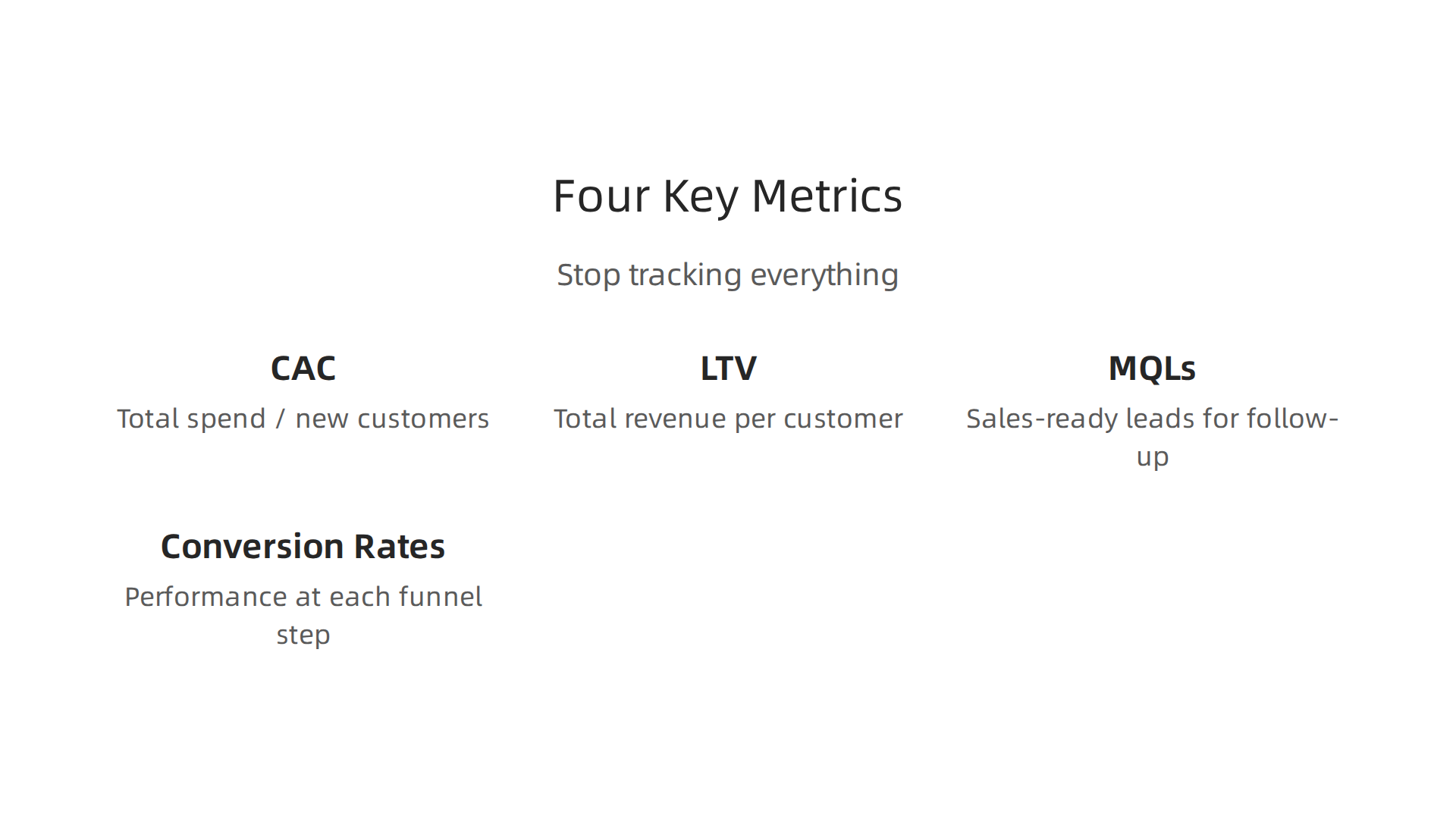
Customer Acquisition Cost (CAC)
This is your total sales and marketing spend divided by the number of new customers. If you spend $20,000 in a month and get 10 new customers, your CAC is $2,000. The goal is to keep this number as low as possible without sacrificing quality. A good rule: your CAC should be less than a third of your customer’s lifetime value.
Lifetime Value (LTV)
LTV is the total revenue you expect from one customer over their entire relationship with you. If your average customer stays for three years and pays $500 per month, your LTV is $18,000. For healthy B2B marketing, your LTV should be at least 3 times your CAC. If it drops below that, you’re losing money on every customer you bring in.
Marketing Qualified Leads (MQLs)
Not every lead is ready to buy. MQLs are the leads that have shown enough interest that your sales team should follow up. Tracking MQLs helps you know if your content, ads, and website are attracting the right people.
Conversion Rates
Look at each step of your funnel:
- Visitor to lead: How many people fill out a form or download something?
- Lead to MQL: How many are ready for sales?
- MQL to customer: How many actually buy?
If conversion is low at any step, that’s your bottleneck.
Setting Up a Simple Dashboard Without Enterprise Tools
You don’t need expensive software. A free tool like Google Looker Studio (formerly Data Studio) can pull data from Google Analytics, Google Ads, and spreadsheets. You can also use Google Sheets with simple formulas.
Start with one sheet. On the left, list your metrics. In the next column, put the current month’s number. In the third column, put your target. The difference tells you what to fix.
If you want to go further, you can automate your SEO reports to save time and get fresh data every week without manual work.
Avoid Vanity Metrics
Vanity metrics are numbers that look good but don’t help you decide. Page views, social media likes, and email open rates are vanity metrics. They make you feel popular but won’t pay the bills.
Instead, track the numbers that tie directly to revenue. Every digital effort should be tied to a specific KPI like cost per lead or return on ad spend. One of the most common digital marketing mistakes small businesses make is failing to track ROI effectively. Don’t fall into that trap.
Align Metrics with Business Goals
Your reports should answer one question: Are we closer to hitting our revenue target? If you’re running account-based marketing for B2B, track pipeline influence and deal velocity. If you’re focused on organic growth, track traffic quality and lead conversion.
The key is to stop measuring everything and start measuring what matters. A simple dashboard with CAC, LTV, MQLs, and conversion rates is all you need to run your B2B marketing like a pro.
Common B2B Marketing Mistakes and How to Avoid Them
Even with the right metrics in place, it’s easy to slip up. B2B marketing has its own rules. Break them, and you waste time and money.

Here are the three biggest mistakes we see in 2026, plus simple fixes.
Mistake 1: Treating B2B Marketing Like B2C
B2C buyers often decide fast based on emotion or price. B2B buyers are different. They research for months, involve multiple people, and need proof before they buy.
The mistake: Using the same flashy, short-term tactics you’d use to sell T-shirts. You run broad ad campaigns, focus on clicks, and expect instant sales. It doesn’t work that way.
The fix: Think long term. B2B marketing is about education and trust. Create content that helps your buyers do their job better. Share case studies with real numbers. Use channels like LinkedIn and industry communities where your buyers already hang out. The 2026 B2B Marketing Strategy Guide from Improvado notes that successful B2B strategies prioritize personalized account-based marketing and educational content to build credibility. That means your goal is not just a click. Your goal is to become the trusted resource they call when they’re ready.
If you’re not sure where to start, you can explore some real marketing examples for small business to see how other companies build trust over time.
Mistake 2: Neglecting Lead Nurturing and Following Up Too Slowly
You run a great campaign. Leads come in. Then nothing happens. You wait a week to call them, or you send one generic email and move on. That’s a huge mistake.
In B2B, most leads are not ready to buy right away. They need time. If you don’t stay in touch, they’ll forget you. And if you follow up too slowly, they’ll pick a competitor.
The fix: Set up a simple nurture sequence. Send a helpful email a day or two after they download something. Then send another a week later with a related tip or case study. Use automation tools so you don’t have to remember every step. The key is to be helpful, not pushy. Keep showing up until they are ready to talk.
Also, follow up fast. Studies show that responding to a lead within five minutes increases your chances of connecting by a lot. Even an hour late can hurt. Have a system to alert your sales team the second a high-quality lead comes in.
Mistake 3: Not Personalizing Outreach and Ignoring Data
Sending the same generic pitch to everyone is lazy and ineffective. Your buyers can tell. They get hundreds of emails a day. If yours looks like it was written for a crowd, they delete it.
The other side of this mistake is not using the data you already have. Your website, email platform, and CRM are full of clues about what your leads care about. Ignoring those clues is like leaving money on the table.
The fix: Personalize based on behavior. If someone visited your pricing page twice, send them a message about ROI. If they downloaded a guide on a specific topic, send them a related case study. Use merge tags in emails, but go deeper than just their first name. Mention the company they work for or the content they viewed.
Also, track which messages get opened and clicked. Double down on what works. Stop sending what doesn’t. A little data goes a long way in making your B2B marketing feel one-to-one.
If you want to avoid these mistakes for good and start growing your business the right way, you can connect your website with Weblish and grow your traffic on autopilot with AI. It’s a simple way to keep your marketing running smoothly while you focus on the big picture.
Summary
This article is a practical, research‑backed roadmap for B2B marketing tailored to small and mid‑sized businesses in 2026. It explains why many SMB websites fail as lead engines and shows how to build a clear foundation: define your ideal buyer, create helpful content, and remove friction so prospects convert. The guide then walks through five high‑impact strategies—account‑based marketing, content + SEO, LinkedIn/social selling, email nurturing, and retargeting—so you can pick one channel and scale. It also gives a step‑by‑step process for vetting agencies, compares hiring in‑house vs. using an agency or hybrid model, and highlights the four metrics (CAC, LTV, MQLs, conversion rates) you must track. Finally, it warns of common mistakes SMBs make and offers simple fixes you can implement without a huge budget.