
Your Marketing Technology for Small Businesses Stack That Generates Leads
This guide shows small and medium businesses how to build a practical marketing technology (MarTech) stack that actually generates leads, without unnecessary co…


Introduction
Does your small business feel invisible when larger brands outspend you for every lead? You are not alone.

Small and medium businesses face real challenges attracting new customers when competitors have bigger budgets and bigger teams.
Here is the good news. Marketing technology has leveled the playing field in 2026. The right tools help you reach the right people without breaking the bank. In fact, according to the SBE Council Tech Use Survey, technology adoption among small businesses has moved well beyond basic websites.
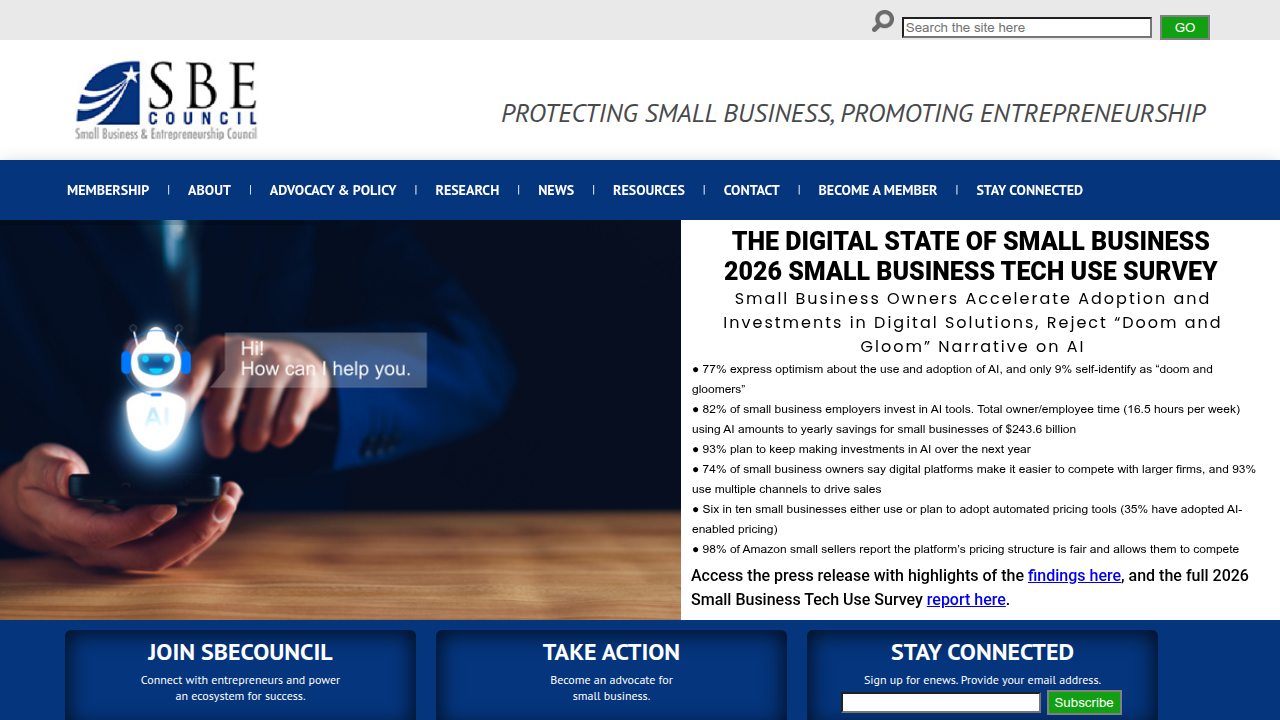
And 63% of SMB leaders believe digital tools will play a critical role in navigating today’s economy.
The problem? Most small businesses still lack a real plan. They jump between tools without direction. Their social media strategy feels random. They struggle with top of funnel marketing because they don’t know which channels actually work. And they miss chances to build magnetic marketing that naturally pulls customers in.
That is why we created this guide. We will walk you through a practical framework for building a MarTech stack that generates consistent leads. No fluff. No confusing jargon. Just a clear path forward.
If hands-off growth sounds better, Weblish offers a done-for-you service that handles web design, SEO, and ongoing marketing management. Get started with Weblish and claim your free trial to see the difference. But if you prefer to build your own strategy, keep reading. We have you covered.
What Is Marketing Technology and Why It Matters for SMBs in 2026
Let’s start with a simple definition. Marketing technology, or MarTech for short, covers all the tools and platforms that help you automate, measure, and improve your marketing. Think of it as your digital toolbox. Every piece has a job, from sending emails to tracking where your leads come from.
For small businesses in 2026, this toolbox is no longer optional. It is the difference between guessing and knowing. Between repeating the same posts and actually growing.
Why MarTech changes everything for SMBs
Here is the honest truth. Most small business owners wear too many hats. You handle sales, customer service, bookkeeping, and marketing all in the same afternoon. Without the right marketing technology, your day disappears into busywork.
A well chosen MarTech stack changes that. It reduces manual effort dramatically. It helps you send the right message at the right time. And it improves lead quality because you stop chasing people who will never buy.
According to Salesforce’s guide on best marketing tools for small business, the essential types of tools every SMB needs include email marketing platforms, social media management tools, and CRM systems. These three categories alone cover most of what you need to generate consistent leads.
The core categories you need to know
You do not need twenty tools. You need the right ones. Here are the four categories that matter most for top of funnel marketing and beyond.
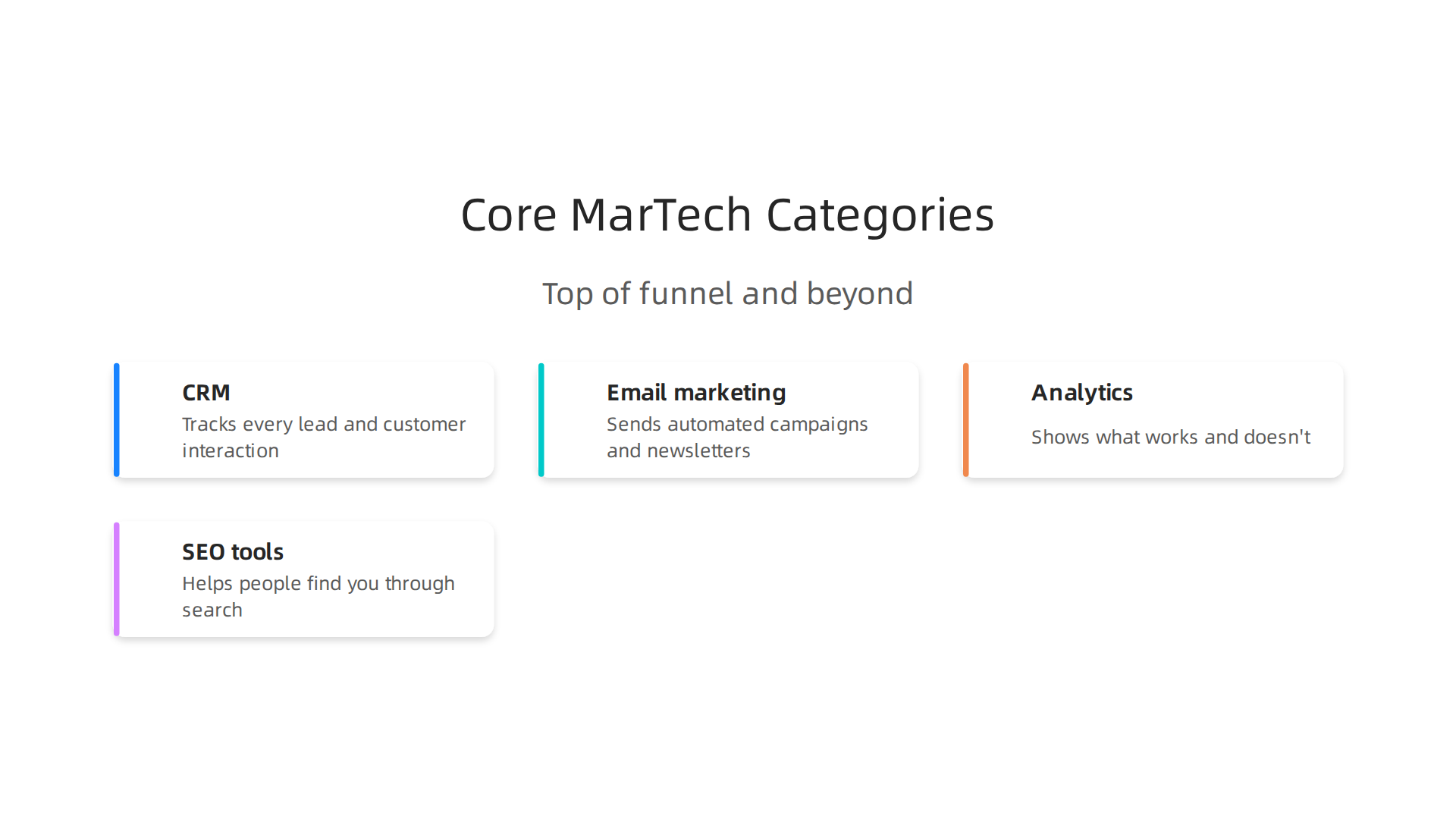
| Category | What It Does | Why You Need It |
|---|---|---|
| CRM | Tracks every lead and customer interaction | Keeps relationships from slipping through the cracks |
| Email marketing | Sends automated campaigns and newsletters | Nurtures leads until they are ready to buy |
| Analytics | Shows what is working and what is not | Stops wasting money on channels that fail |
| SEO tools | Helps people find you through search | Drives free, consistent traffic over time |
Platforms like HubSpot’s Marketing Hub combine several of these into one system, which can simplify things if you are just starting out. But the key is picking tools that actually fit your business, not just the ones with the biggest ads.
Where influencer marketing platforms fit in
One category that often gets overlooked is influencer marketing. You do not need celebrities. You need micro influencers who already have the trust of your ideal customers. The right platforms help you find, vet, and manage these partnerships without a full time team.
If going influencer feels like too much to tackle solo, that is where a service like Weblish comes in. We handle the strategy, the website, and the ongoing marketing so you can focus on running your business. Get started with Weblish and claim your free trial to see what a fully managed approach looks like.
Building your magnetic marketing foundation
Understanding these categories is your first step. But knowing what tools exist and actually building a system that works are two different things. That is why we created a full walkthrough on how to create an internet marketing strategy that generates leads for your small business. It connects the dots between the tools and the results you actually want.
The goal is simple. Build a stack that supports your social media strategy, your email campaigns, and your overall marketing technology without making your life harder. Start with the categories above. Pick one tool per category. Get it working well before adding more.
That is how you turn marketing technology from a confusing buzzword into a real lead generation machine.
Building Your Essential MarTech Stack: Core Tools for Customer Acquisition
You now know what marketing technology covers. But knowing the names of tools is not the same as building a stack that actually works. The real goal is customer acquisition. To get there, you need a solid foundation that grows with you.
The three tools every SMB needs first
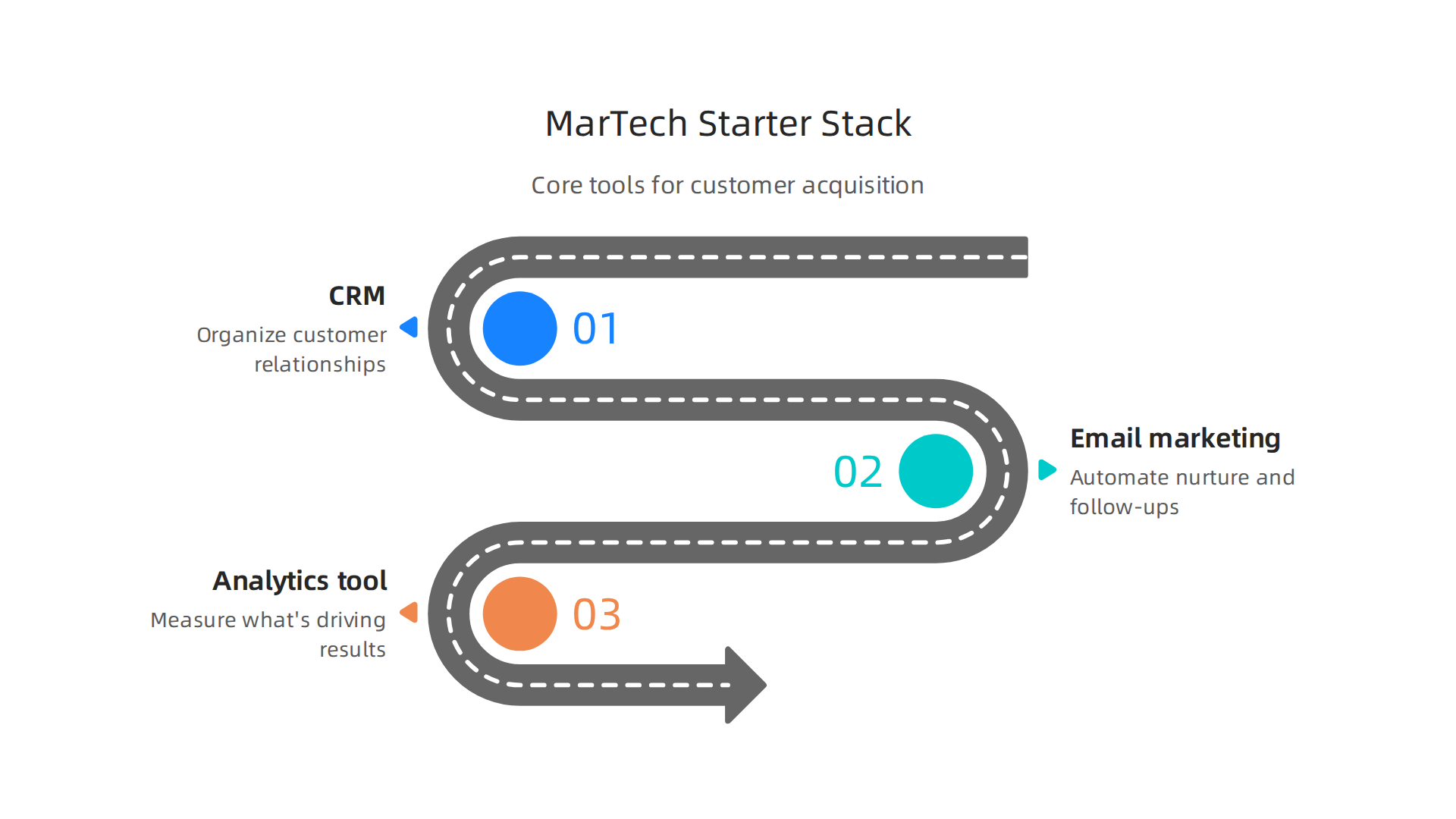
Do not overthink it. Start with a CRM, an email marketing platform, and an analytics tool. These three form the backbone of your entire customer acquisition system.
According to Salesforce’s guide on the best marketing tools for small business, these three categories support everything from tracking leads to closing sales.
Your CRM keeps every relationship organized. Your email platform lets you send automated follow ups. Your analytics tool shows you what is actually driving results.
Pairing tools that integrate well prevents data silos. For example, combining a CRM with your email marketing means you can see exactly when a lead opens an email or clicks a link. That context helps you send the right message at the right time. It also strengthens your overall top of funnel marketing because nothing slips through the cracks.
Platforms like HubSpot Marketing Hub combine several of these functions into one system. This reduces the need to jump between different logins and keeps your data clean and consistent.
A phased approach reduces overwhelm
Here is the truth. You do not need to buy everything at once. Trying to set up ten tools in one week is a recipe for burnout.
Instead, take a phased approach. Start with your CRM and email platform.

Get those working smoothly in your daily workflow. Once you feel confident, add analytics so you can measure your social media strategy and see which channels bring the best leads.
After that, layer in tools that support specific goals. For instance, influencer marketing platforms can help you find and manage partnerships. SEO tools can drive free traffic over time. Each new piece should fit naturally into the stack you already built.
This gradual method helps you build a magnetic marketing system without the high upfront cost or complexity. You grow your marketing technology stack at the same pace your business grows.
Let an expert handle the heavy lifting
Building and managing this stack takes time. You have to research tools, connect integrations, and monitor performance. If that sounds like a distraction from running your business, you are not alone.
Weblish handles the entire process for you. We build the strategy, set up the tools, and manage everything from web design to email campaigns. You get a fully managed marketing technology system without the headache. Get started with Weblish and claim your free trial to see how simple customer acquisition can be.
For a complete walkthrough on structuring your digital presence, take a look at our guide on how to create an internet marketing strategy that generates leads for your small business. It connects the dots between your tools and the results you actually want.
Turning Your Website from a Brochure into a Lead-Generation Machine
Does your website feel more like a digital business card than a sales engine? You are not alone. Many small business owners invest time and money into a site that just sits there. Visitors come, look around, and leave. No form fills. No calls. No revenue.
The fix is not a complete redesign. It is turning your existing site into a lead generation machine using the right marketing technology.
Three changes that make the biggest difference
First, your website needs clear calls to action on every page. Do not make visitors guess what to do. Tell them. Use buttons like "Get Your Free Quote" or "Download the Guide." Pair those with dedicated landing pages for each campaign. A landing page removes distractions and focuses the visitor on one action.
Second, reduce friction in your forms. Ask for only the information you truly need. If you ask for a phone number and a full address on the first form, many people will bounce. Keep it simple. Name and email is often enough to start a conversation.
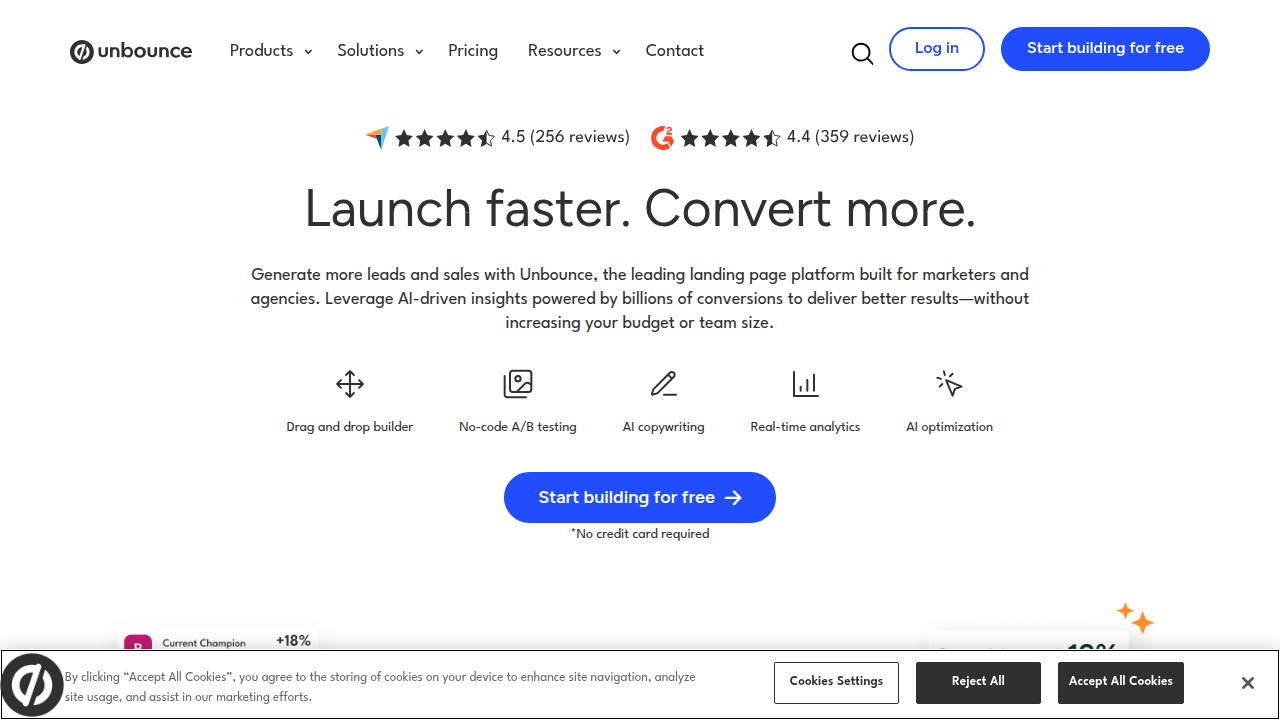
According to Unbounce’s guide on AI marketing tools, optimizing landing pages and reducing form friction are proven ways to boost conversion rates.
Test your way to better results
Here is a simple truth. You do not know what works best until you test it. A/B testing lets you try two versions of a headline, a button color, or even the layout of a form field. Over time, these small changes can lift your conversion rate by 20 to 30 percent.
AI tools can make this testing faster. For example, SDLC Infotech’s list of best AI tools for small businesses includes platforms like AdCreative.ai that help you test ad creatives and landing page elements automatically. The less manual work you do, the more you can focus on strategy.
Connect your website to your CRM and email
This is where your overall marketing technology stack comes together. When a visitor fills out a form on your site, that data should go straight into your CRM. Your email platform should then send an automated follow up. No manual data entry. No forgotten leads.
This creates a smooth top of funnel marketing system that works while you sleep. For a step by step guide on setting this up, check out our tutorial on how to build a lead generating website.
Let an expert handle the details
All of this takes time. You need to set up integrations, run tests, and monitor results. If that sounds like a distraction from actually running your business, you are not alone.
Weblish builds and manages the entire website optimization process for you. From clear CTAs to automated email flows, we turn your site into a consistent lead generation engine. The result is a truly magnetic marketing system that attracts and converts visitors day after day.
Leveraging Automation and AI in Your Marketing Technology
You have optimized your website for leads. Forms work. Data flows into your CRM. Emails send automatically. But now you are handling that flood of new leads, posting on social media, and sending follow ups all by hand. It is a lot. And honestly, it is not sustainable.
This is where your marketing technology stack gets smarter. Automation and artificial intelligence can take over the repetitive tasks so you can focus on strategy and sales.

Automation handles the heavy lifting
Automation tools manage email sequences, social media posting, and even lead scoring. Instead of manually sending a welcome email every time someone signs up, you set it once and it runs forever. Instead of logging into five platforms to share a blog post, you schedule it in one place.
Think about your top of funnel marketing. A new visitor downloads a guide. Automation sends them a follow up email three days later. Then another email one week later with a case study. No extra work from you. The system nurtures the lead while you sleep.
AI makes your marketing smarter
AI powered tools now do more than just automate. They personalize. They predict. And here is the best part. They are affordable for small businesses.
For example, AI can recommend personalized content to each website visitor based on their behavior. It can score leads so you know which ones to call first. According to the experts at Unbounce, AI marketing tools can boost your productivity and improve conversion rates. That is a direct lift to your bottom line.
Tools like ChatGPT help with writing emails and social posts. Surfer SEO helps you optimize content for search engines. AdCreative.ai generates ad images and copy automatically. SDLC Infotech lists these as some of the best AI tools for small businesses in 2026. The key is choosing tools that fit your specific needs.
Start small, then expand
Do not try to automate everything at once. Pick one or two processes that take up the most time. Maybe it is your email follow ups. Maybe it is social media scheduling. Automate those first.
Once you see how much time you save, add another automation. Maybe lead scoring. Maybe personalized content recommendations. The goal is to build a magnetic marketing system that works consistently without burning out your team.
Need help setting up automated email flows? Check out our guide on how to build a drip marketing campaign that converts for your small business. It walks you through the exact steps.
The bottom line
Automation and AI are not just for big companies anymore. They are accessible, affordable, and essential for any small business that wants to grow. Start with one simple automation. Let the machine do the grunt work. You focus on building relationships and closing deals.
Integrating Your MarTech Tools for Seamless Data Flow
You have set up automation and AI. Your CRM holds leads. Your email tool sends sequences. Your analytics tracks visits. That is all good.
But here is the thing. Are these tools talking to each other?
If your CRM and email tool do not share data, you miss connections. If your analytics and ad platform do not sync, you waste money. Your marketing technology stack needs to work as one system.
The silo problem
When your tools sit in silos, you lose the big picture. You cannot see which email led to a sale. You cannot see which ad drove a visit. You guess instead of knowing.
The team at Factors.ai says one of the biggest challenges in 2026 is cutting tool sprawl and ensuring your stack actually drives revenue. You need your tools to play together.
How to connect everything
You do not need to be a developer to sync your tools. Integration platforms like Zapier act as the bridge. When a new lead fills out a form, Zapier can add them to your email list, create a CRM record, and send a Slack alert. No coding needed.
Many tools also offer native connections. Your CRM might already talk to your email platform. Your analytics might already talk to your ad platform. Look for these first. They are usually faster and more reliable.
The payoff of seamless data flow
When data flows freely, you get real insights. You can finally see the full customer journey from first click to final sale.
The HubSpot State of Marketing Report for 2026 shows that small businesses are 23% more likely to see ROI from blog posts when they track the right metrics. Integration makes this tracking possible.
A connected system also supports your top of funnel marketing efforts. You can see exactly which channels bring in the best leads. You can nurture them better. You can build a truly magnetic marketing system that runs itself.
Watch out for these pitfalls
Integration is powerful, but it has risks.
First, over automation. Do not automate a broken process. Fix the process first, then connect the tools.
Second, dirty data. If your contact records are messy, your integrated system will spread that mess everywhere faster. The experts at Pedowitz Group stress that solid marketing ops depend on clean data and governance models to drive ROI. Make data hygiene a habit.
Start small. Connect two tools.
Pick the two most important tools in your stack. Connect them first. See how seamless data flow changes your decisions.
Need a practical example? Check out our guide on how to build a drip marketing campaign that relies on this exact kind of integration. It shows you the exact steps.
Integration turns a pile of tools into a real system. And a real system drives real growth.
Measuring ROI of Your Marketing Technology Investments
You have your tools connected. Data flows freely now. But you still need to answer the big question. Is all this marketing technology actually paying off?
The team at Factors.ai says the smartest marketers in 2026 focus on proving revenue from their tools, not just using them. You need to measure what matters.
The metrics that actually tell the story
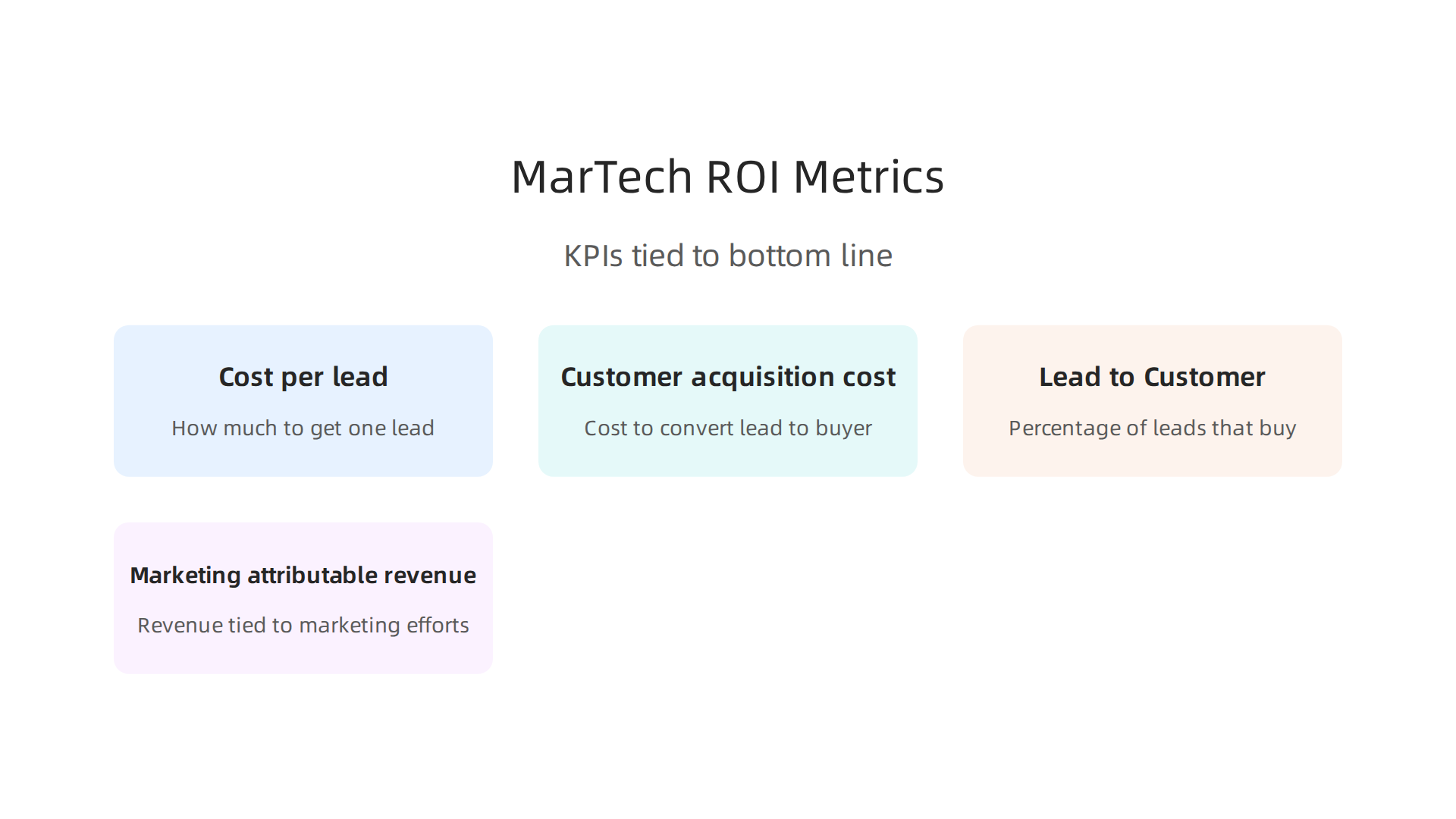
Stop tracking vanity numbers like email open rates or page views alone. Track the metrics that connect directly to your bottom line.
Here are the key ones:
- Cost per lead. How much do you spend to get one new lead?
- Customer acquisition cost. What does it cost to turn that lead into a paying customer?
- Lead to customer conversion rate. What percentage of your leads actually buy?
- Marketing attributable revenue. How much revenue can you directly tie back to your marketing efforts?
The experts at the Pedowitz Group recommend building a solid business case around these KPIs. When you track the right numbers, you can prove exactly what your stack delivers.
Attribution models help you see the full picture
Here is where it gets interesting. A lead might find you through a blog post first, then click a social media ad, then open an email, then finally buy. Which tool or channel gets the credit?
That is where attribution models come in.
A first touch model gives credit to the first interaction. A multi touch model spreads credit across every step. Multi touch is usually more accurate because it shows the full customer journey.
The data backs this up. According to Nucleus Research, businesses earn $5.44 for every dollar spent on automation over three years. That is a 544% return. But you only see that return when you track it properly.
Use the data to make smarter decisions
Here is the real power of measuring ROI. When you know which tools perform and which do not, you can move budget around.
Stop paying for an influencer marketing platform that brings in few leads. Put that money into your social media strategy if that channel converts better. The same logic applies to your top of funnel marketing efforts. If blog content drives the best leads, double down there.
Need help building a strategy that uses these insights? Check out our guide on how to create an internet marketing strategy that generates leads. It shows you how to turn data into action.
Make review a habit
Do not measure once and forget. Set a monthly review of your marketing technology performance. Look at the key metrics. Ask what is working and what is not.
This regular checkup turns your stack into a lean, revenue driven system. It is the difference between guessing and knowing. And in 2026, the businesses that know win.
Overcoming Common MarTech Challenges for SMBs
Measuring ROI is the dream. But let’s be real. Small businesses face some tough hurdles when they try to build their marketing technology stack. The good news? You can beat every single one.
Budget constraints are real
You do not have a Fortune 500 budget. That is okay. Many tools offer free or low‑cost starter plans. You can begin with one solid free tool and add more as you grow. According to the experts at Small Business Xchange, you can build a powerful marketing technology stack without breaking the bank by starting with affordable, essential pieces. This guide to building an affordable martech stack walks you through exactly what to pick.
Start with a free email marketing tool or a simple CRM. Focus on one channel first, like email or social. When you see results, you can invest in paid upgrades. That way, your influencer marketing platforms or more advanced tools only come when you have proven they will pay off.
Lack of internal expertise slows you down
Maybe you are a business owner, not a tech genius. That is fine. You just need tools that are easy to use. Look for platforms with drag‑and‑drop builders, clear tutorials, and active support communities. The American Marketing Association points out that many small businesses end up with complex, disjointed stacks because they pick tools that demand too much know‑how. Choosing the right fit from the start helps you avoid that mess.
You can also learn as you go. Free courses on YouTube and blogs about social media strategy or top of funnel marketing give you the skills you need. And remember, a tool that does everything (like a simple all‑in‑one marketing platform) often requires less expertise than a huge suite of separate apps.
Vendor lock‑in can trap you
Here is a hidden danger. You sign up for a tool, import all your data, and then find out you cannot easily leave. That is vendor lock‑in. It can cost you time and money if you ever want to switch.
The solution is simple. Before you commit, check if the tool lets you export your data easily. Look for open APIs that connect to other platforms. The folks at Martech Zone advise startups to plan ahead by choosing flexible tools that avoid dependency on one vendor. Their tips on avoiding lock‑in are worth reading.
Also, pick tools that work well with others. A tool that plays nicely with your CRM, email service, and analytics will keep your stack flexible.
You can do this
These challenges are common, but they are not stop signs. Start small. Pick user‑friendly tools. Keep your data portable.

Need a step‑by‑step plan? Check out our guide on how to create an internet marketing strategy that generates leads — it helps you build a solid foundation for your marketing technology stack.
When you tackle these obstacles head on, your stack becomes a magnetic marketing engine that works for you, not against you.
The Role of a MarTech Partner: When to Seek Help
You have tackled budget limits, expertise gaps, and vendor lock‑in. Your stack is starting to work. But here is the truth even the best business owners face. There comes a point where managing your marketing technology stack on your own becomes too much.
Maybe you now have a CRM, an email tool, a social scheduler, and an analytics platform. Getting them all to talk to each other takes hours. Setting up campaigns feels like a part‑time job. And you are still the one who has to fix things when something breaks. According to the American Marketing Association, many small businesses end up with very complex and disjointed martech stacks because they add tools without a plan. Their research shows this is a common problem. That complexity is a signal you need a partner.
Signs you need help
Look for these signs. You spend more time managing tools than using them. Your social media strategy suffers because you cannot keep up with posting and analytics. Your top of funnel marketing efforts stall because you lack data to improve. And your ROI is still a guessing game. The team at Velocity Partners explains that SMB marketing is uniquely hard because you have limited resources but must compete with bigger players. That difficulty is real. A MarTech partner can step in and handle the heavy lifting.
What a good partner does
A trusted partner brings strategy, implementation, and ongoing management. They set up your tools so they work together smoothly. They build campaigns for influencer marketing platforms and automate your email flows. They also monitor your magnetic marketing efforts to keep everything running. You get to focus on your customers and your product.
What to look for
Not all partners are created equal. Look for transparency. They should show you clear pricing with no hidden fees. They should have experience with businesses like yours. Ask about their onboarding process. A good partner will help you clean up your data and connect your tools from day one.
One option worth checking out is Weblish. They offer a done‑for‑you growth service with affordable monthly pricing. No upfront website build fees. They handle web design, SEO, social media, and email marketing so you can stop worrying about your tech stack. Sign up for the free trial here: Weblish — Free Trial.
Your next step
If you want to build a solid foundation before bringing in a partner, start with a clear plan. Our guide on how to create an internet marketing strategy that generates leads walks you through the essentials. Then, when you feel the weight of too many tools, you will know exactly when to call for backup.
A MarTech partner can turn your stack into a quiet engine that runs in the background. And that gives you the freedom to grow your business without the technical headaches.
Summary
This guide shows small and medium businesses how to build a practical marketing technology (MarTech) stack that actually generates leads, without unnecessary complexity or cost. It explains what MarTech is, the four core tool categories you need (CRM, email, analytics, SEO), and why starting with three essentials—CRM, email, analytics—gives you the biggest early wins. The article walks through turning a brochure website into a lead-generating machine with clearer CTAs, simpler forms, and A/B testing, then covers automation and AI to save time and personalize outreach. It also explains how to connect tools for seamless data flow, measure ROI with meaningful metrics, and avoid pitfalls like vendor lock‑in or dirty data. Practical phased steps and examples help you grow the stack as your business scales, and it outlines when bringing in a MarTech partner (like Weblish) makes sense to free you up to run the business.