
Why Your Business Needs a Private Search Engine in 2026
This article explains why search privacy is a business concern, not just a personal choice, and shows how adopting privacy-first search tools can reduce data le…


Why Privacy in Search is a Business Issue, Not Just a Personal One
Think about your last search. Maybe you looked up a competitor’s service, researched a new market trend, or checked customer reviews. That simple act, repeated across your team, creates a digital footprint. This footprint is more than personal. It is a business asset, and increasingly, a business risk.
For years, we saw privacy as a personal choice. But in 2026, the game has changed. The growing demand for privacy is a direct response to the vast data collection by dominant platforms. When your team uses a standard search engine, every query can reveal your strategic interests, operational challenges, and market research. This isn’t just about seeing ads for shoes you already bought. It is about protecting your business’s sensitive information from data leaks, competitive intelligence gathering, and the slow erosion of customer trust.
The numbers are clear. Recent surveys show that about 75% of consumers will not purchase from companies they do not trust with their data. Furthermore, 61% of Americans say limiting who has access to their data is very important to them. Your customers are paying attention. If they perceive your business as careless with data, they will go elsewhere.
This is where your default search engine comes in. It is a daily habit with massive implications. Continuing to use tools that profile and track every search puts your business at risk. It can expose internal plans and make you vulnerable. The promise of a private search engine is that it can be part of a responsible, trustworthy digital strategy. It is a practical step any small or mid-sized business can take to lock down one major source of data leakage and build a foundation of operational security.
Understanding and adopting private search is no longer a niche techie move. It is a smart business practice. For SMBs feeling overwhelmed by where to start with a more secure digital presence, services like Weblish provide a managed path forward. They help build and maintain a professional, fast, and secure online foundation, allowing you to focus on growth while knowing your digital tools are working for you, not against you.
What is a Private Search Engine? Defining the Core Principles
Let us start with what it is not. A private search engine is not your default search engine.
Your default search engine, like Google or Bing, works by creating a detailed profile of you. It logs your searches, links them to your identity, and uses that data to personalize results and target ads. The core technology of these large scale engines, as described in foundational research, relies heavily on analyzing vast amounts of web data and, by extension, user data to function.
A private search engine flips this model on its head. In simple terms, it is a search tool designed from the ground up to find the information you need without tracking who you are. As one provider explains, these are often called "no tracking search engines" because they do not monitor your online activities. Their primary goal is to give you relevant results, not to build a dossier on you or your business.
Here is a crucial point many people miss. Using a private search engine is fundamentally different from using your browser’s "incognito" or "private browsing" mode. That mode only stops your browser from saving your history and cookies locally on your device. It does not stop the search engine itself, or the websites you visit, from seeing and logging your activity. As a detailed study on private browsing modes notes, these features have specific and limited goals, mainly local privacy. A true private search engine ensures the search provider itself does not collect your data in the first place.
So, what are the core principles that make a search engine "private"? They typically include:
- No Search History Logging: Your queries are not stored in a way that can be linked back to you. After your search is complete, it is forgotten.
- No Personalized Profiling: You get the same search results as anyone else typing the same words. The engine does not use your past behavior, location (unless you allow it for local results), or demographic data to filter what you see.
- Blocking of Hidden Trackers: Many private search engines, like the DuckDuckGo search engine, also act as a shield.
They prevent the hidden third party trackers, commonly found on websites, from following you after you leave the search page.
This raises a good question. If they are not selling your data, how do private search engines make money to stay in business?
The answer lies in more ethical business models. Some, like Kiddle search engine (a safe search engine for kids), are funded by parent organizations or grants. Others use a privacy focused version of advertising. They might show ads based only on the keyword you searched for at that moment, not on your personal profile. A few offer premium subscription plans for advanced features or completely ad free searching. This shift proves that a search service can be valuable and sustainable without exploiting user privacy.
For a business, choosing a private search engine is a clear operational decision. It is about choosing a tool that respects your strategic confidentiality by design. It removes a key point of data leakage from your daily workflow. If the idea of overhauling your business’s digital tools to be more secure and private feels daunting, a managed service can handle the heavy lifting. A service like Weblish helps businesses build and maintain a secure, professional online foundation, allowing you to adopt better tools and practices without the stress.
How They Work: The Technology Behind Privacy-First Search
You might wonder, if a private search engine doesn’t track you, how does it actually find anything? The magic happens through a few clever technical approaches that separate your identity from your search.
First, they act as a privacy shield. When you use a private search engine like DuckDuckGo, your query often goes through the engine’s own servers first. These servers act as a proxy, or a middleman.
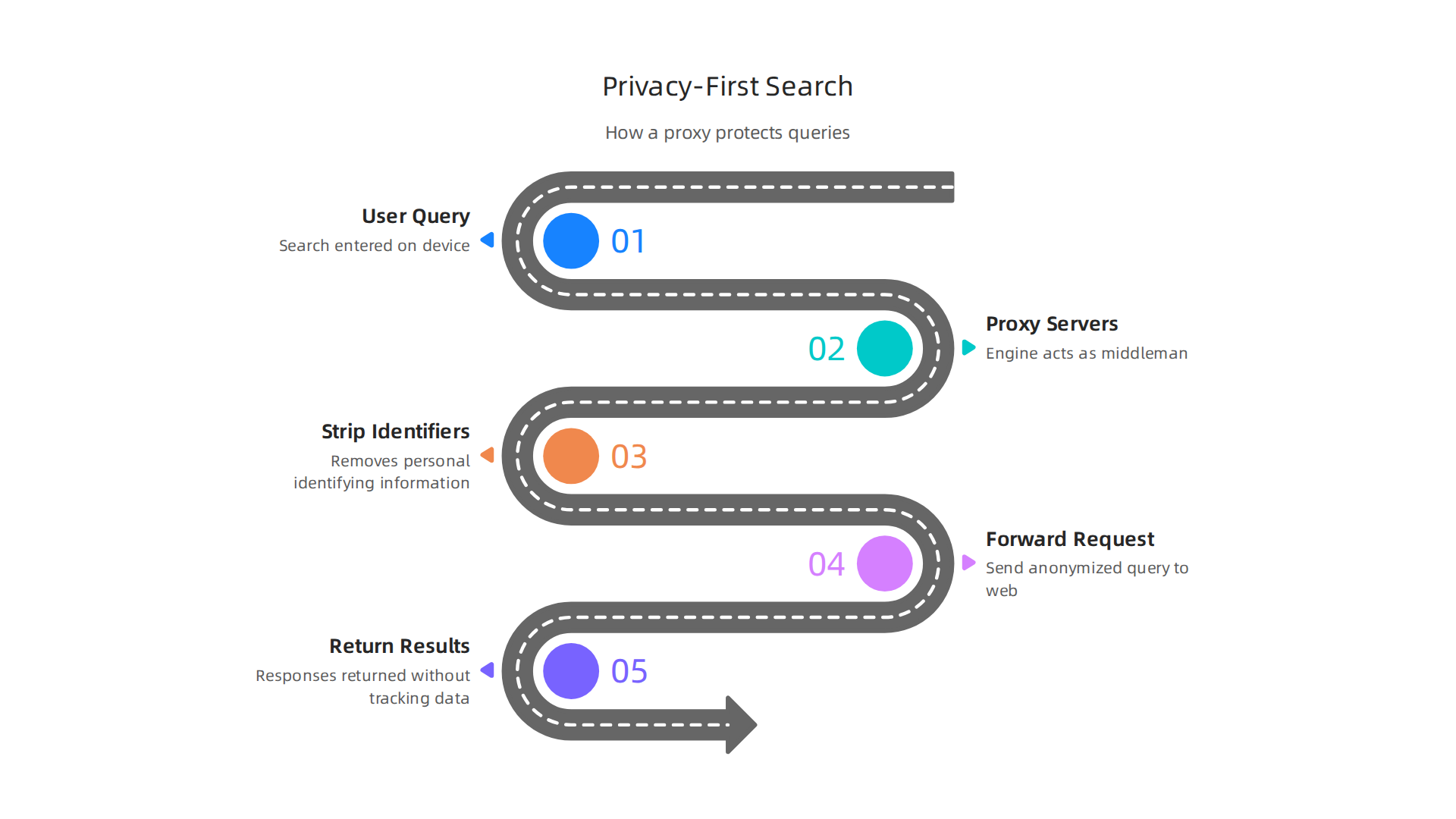
They strip away your personal identifying information before forwarding the search to get results. This process, part of a broader discipline called information retrieval, is designed to deliver answers without knowing who asked. The core goal is to be a no-tracking search engine.
So where do the results come from? Most private engines don’t build a massive web index from scratch like Google does. Instead, they partner with other companies to source results. Some use APIs from larger providers like Bing or Yandex, but they do so anonymously. They send thousands of mixed-up queries at once so no single search can be linked to an individual user. Others, like Brave Search, are now building their own independent indexes to break away from reliance on big tech entirely.
For the ultimate level of anonymity, some services integrate with the Tor network. Tor bounces your internet connection through multiple volunteer-run servers around the world, encrypting it each step of the way. This makes it extremely difficult for anyone, including the search engine, to trace the query back to your location or device.
The technology ensures that during your search, as noted in search architecture overviews, only the search index is involved in finding your answer, not your personal profile. This is the fundamental shift from a default search engine model built on personal data to one built on privacy. For a business, adopting these tools is a strategic move toward operational security. If implementing these privacy-first technologies feels complex, a managed service can streamline the process. You can get started with Weblish by signing up and claiming your free trial to build a secure and professional online foundation that respects your confidentiality.
Private Search vs. Mainstream Search: A Side-by-Side Comparison
Choosing a search engine can feel like picking between privacy and power. Let’s break down the real differences between a private search engine and a mainstream default search engine like Google.
Think of it this way: one sees you as a person, the other sees you as a query. Mainstream engines build a detailed profile of you. They track your searches, location, and clicks to tailor ads and results. As privacy advocates note, this turns your data into a product. A private search engine, however, operates on a no-tracking principle. Your searches aren’t linked to your identity, stored long-term, or used to build an advertising profile.
Here is a simple comparison:
| Aspect | Mainstream Search (e.g., Google) | Private Search (e.g., DuckDuckGo, Brave Search)
What does this mean for you? Mainstream search offers a convenient, feature-rich experience that learns your habits. A private search engine offers a more uniform, unbiased view of the web where you control your digital trail.
For a business, the choice affects your visibility. Marketing on a platform where users block trackers requires focusing on context, not cookies. Understanding this landscape is key to building a resilient online presence. If navigating this new privacy-focused web seems daunting, a service like Weblish can help. You can get started with Weblish by signing up and claiming your free trial to build a professional site that performs well, no matter how your customers choose to search.
The Tangible Benefits and Real-World Limitations for Businesses
Understanding the difference between a private search engine and a default search engine is one thing. Applying that knowledge to your business strategy is another. For a company, the choice isn’t just philosophical. It has real impacts on security, research, and even brand reputation.
Let’s look at the concrete advantages first.
Key Benefits for Your Business
- Enhanced Security for Sensitive Research: When your team looks up market trends, potential partners, or legal issues, a private search engine doesn’t log that activity. This means sensitive queries aren’t stored in a profile that could be breached or accessed. As a 2025 survey highlights, data breaches are a top concern for 64% of respondents. Using a private search tool is a simple layer of protection against this risk.
- Protection of Competitive Intelligence: Your search history can reveal your strategy. Are you researching a competitor’s product, a new location, or a supplier? A mainstream engine can connect those dots. A private search engine like DuckDuckGo or Brave Search treats each query in isolation, helping shield your strategic moves from prying eyes.
- Alignment with Corporate Values (CSR): Consumer trust is directly tied to privacy. Recent data shows about 75% of consumers will not buy from companies they don’t trust with their data. By advocating for or using privacy-respecting tools, you demonstrate alignment with these values. This isn’t just ethical. It’s good business, building trust in an era where, according to a 2026 report, 86% of Americans say data privacy is a growing concern.
- Mitigating Insider Threat Risks: Not all risks are external. A private search engine minimizes the digital footprint left by employees. This limits the potential damage from accidental leaks or malicious internal activity, as there is no persistent search history linked to your company’s network or accounts to exploit.
Understanding the Practical Limitations
However, switching entirely to a private search engine isn’t a perfect solution for every business task. It’s important to know the trade-offs.
- Less Personalized & Local Results: A default search engine like Google excels at providing results tailored to your location and past behavior. For a business searching for "best coffee supplier," a private search engine might give generic results, while Google could highlight highly-rated local vendors. This can slow down certain types of commercial research.
- Different SEO Dynamics: If your marketing team uses a private search engine to check your site’s ranking, they’ll see an unpersonalized view. This is great for understanding a "vanilla" ranking, but it misses how your site appears in the personalized results of your actual customers. Your SEO strategy needs to account for both views.
- Potentially Slower Feature Innovation: Mainstream engines rapidly integrate new features like AI-powered shopping, detailed local maps with inventory, and travel booking. Privacy-first engines, often with smaller teams, may adopt these ancillary services more slowly or through basic partnerships.
A Balanced Perspective for 2026
So, when is a private search engine a critical tool, and when might it hinder your team?
Use a private search engine when:
- Conducting sensitive market or legal research.
- Protecting early-stage product development or acquisition plans.
- You want to audit your website’s unbiased search visibility.
- Your brand wants to actively promote and practice data minimization.
Rely on a mainstream default search engine when:
- Your team needs hyper-local business intelligence or directions.
- Using integrated productivity suites (like finding a file in Google Drive via search).
- Speed and deep integration with other business tools (like Maps, Flights) is the priority.
The smartest approach is often a hybrid one. Train your team to use the right tool for the job. Make a private search engine the default for general web browsing and sensitive work. Switch to a mainstream engine for specific, location-based commercial tasks.
Implementing this balanced, privacy-aware workflow can seem complex. If your business needs a website and digital strategy built for this modern, privacy-conscious landscape, a managed service can handle the technical heavy lifting. You can get started with Weblish by signing up and claiming your free trial to build a fast, secure, and effective online presence that respects your data and your customers’.
How Private Search Impacts Your Digital Marketing and SEO
You have your team using a private search engine for sensitive tasks. That’s great for security. But now your marketing lead has a question: "If our potential customers are using DuckDuckGo or Brave Search, how does that change our SEO strategy?"
It’s a smart question. The rise of the private search engine doesn’t make SEO irrelevant. It changes what you need to focus on. Here’s what you must know in 2026.
The Data You Lose (And Why It Matters)
When someone uses a default search engine like Google while logged in, the engine uses a massive amount of personal data to tailor results. It knows their location, past searches, and click behavior. As a marketer, tools built around Google give you insights into this personalized landscape.
A private search engine strips that away. It doesn’t track the user. Therefore, it cannot create a personalized results page. For you, this means:
- Blind Spots in Keyword Tracking: Your ranking reports show a "vanilla" result. You won’t see how a user’s personal history might boost or bury your site for them specifically.
- Less Reliance on "Signals": Some SEO strategies are built on gaming signals that a personalized engine values, like a user’s prolonged history with a brand. These signals hold less weight in a private search context.
In short, the playing field is leveled. Your site is judged more on its raw merit for the query, not on the searcher’s past relationship with you.
The New (Actually Old-School) Focus: Authority and Relevance
This shift pushes digital marketing back to its foundational principles. If you can’t rely on personal data to influence rankings, what can you rely on?
The answer is what search engines have always claimed to value most: true authority and genuine topical relevance.
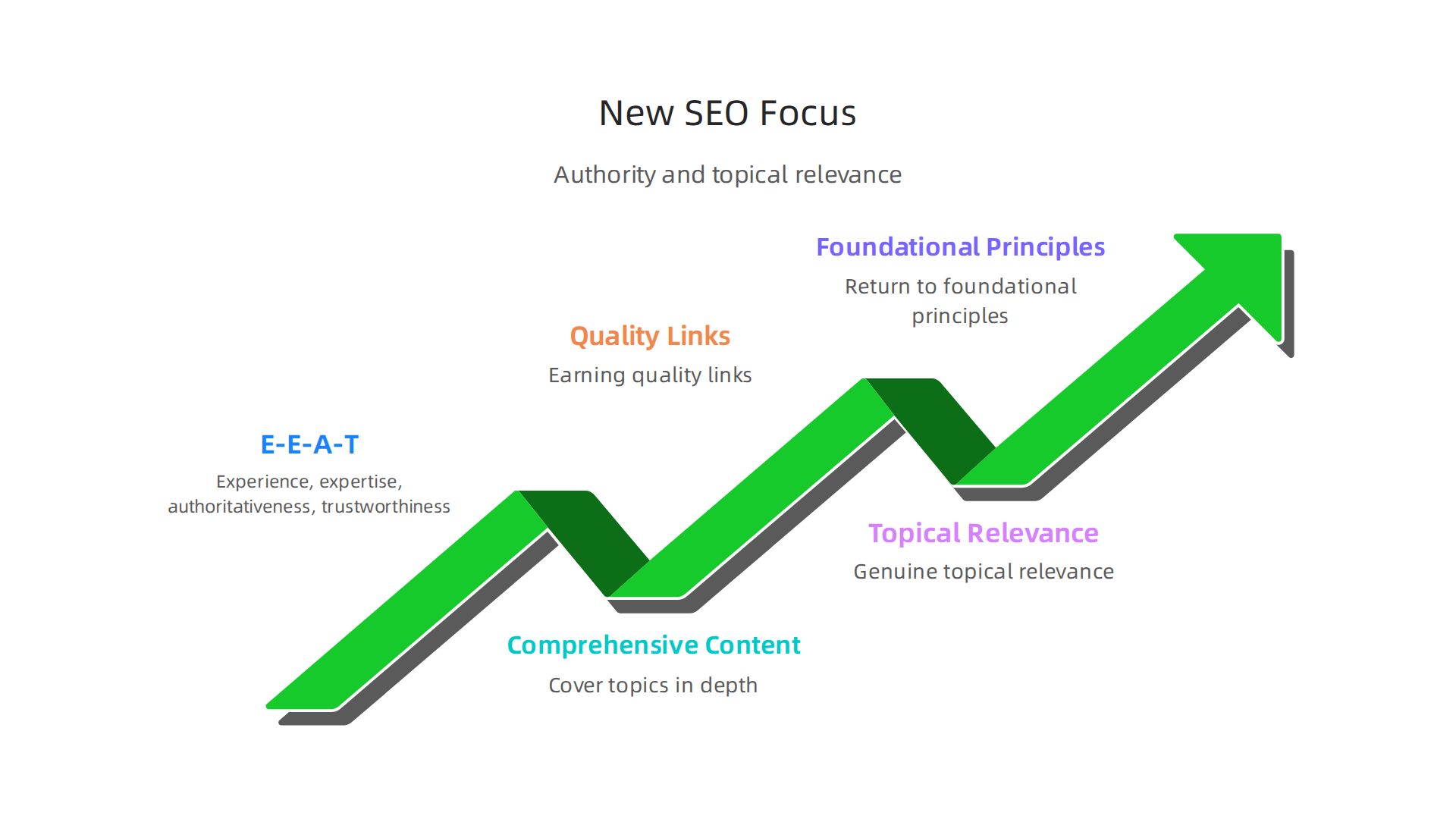
Research into Google’s ranking factors consistently highlights trustworthiness and content quality as top signals. These factors are universal, whether the search is personalized or not.
This means your strategy must emphasize:
- E-E-A-T (Experience, Expertise, Authoritativeness, Trustworthiness): Demonstrate why you are a credible source. Use clear author bios, cite reputable sources, and showcase real expertise. This builds the trust that all search engines seek to reward.
- Comprehensive, User-First Content: Answer the query thoroughly. As one 2025 analysis noted, "Text relevance has the highest correlation with search rankings". Create the best, most useful answer, not the one stuffed with keywords.
- Earning Links, Not Just Building Them: Backlinks from other authoritative sites are a huge vote of confidence. A guide to ranking factors lists "Backlinks from Authoritative Websites" as a top factor. Focus on creating link-worthy content that others in your industry will want to reference.
What Doesn’t Change: The Non-Negotiables
Here’s the good news for marketers. The core technical bedrock of SEO becomes even more critical when personalization is removed. These are the factors you must absolutely nail:
- Technical SEO: Your site must be crawlable and indexable. Clean site architecture, proper use of headers, and fast-loading pages are not optional. A comprehensive 2025 guide on ranking signals treats these as essential.
- Page Speed & Mobile Experience: Users on any search engine hate to wait. Page speed is a direct ranking factor and a critical user experience metric. Ensuring your site is mobile-friendly is equally non-negotiable.
- Secure & Accessible Website: HTTPS is a basic standard. Your site should be accessible to all users and secure from threats.
Think of it this way: a private search engine acts like a strict, impartial judge. It ignores the noise of personal history and focuses squarely on the quality of your website’s construction and content. Your job is to build a site that meets that high standard.
Building and maintaining a website that excels in these universal areas—technical performance, security, and authoritative content—requires consistent effort. For many businesses, managing this on top of daily operations is a major challenge. A service like Weblish handles this technical heavy lifting, building and managing fast, secure websites designed to perform well in any search environment, personalized or not. You can get started with Weblish by signing up and claiming your free trial to build a foundation that works for every searcher.
Evaluating and Choosing a Private Search Engine: A Decision Framework
You understand why a private search engine matters for security and how it changes your marketing. The next question is, which one should your team actually use? The choice isn’t just about picking the most famous name. Different engines have different strengths, privacy models, and features.
With so many options in 2026, from DuckDuckGo Search Engine to newer entrants, you need a clear way to decide. Think of it like choosing a new tool for your workshop. You wouldn’t buy the first one you see. You’d check its specs, how it’s built, and if it fits the job. Let’s build your decision framework.
Key Criteria for Your Evaluation
Not all private search engines are created equal. To find the right fit, look closely at these five areas.
1. Privacy Policy Clarity and Audits
A true private search engine should have a simple, straightforward privacy policy. It must clearly state what data it collects (if any), how long it’s kept, and who it’s shared with. Even better, look for engines that undergo regular independent privacy audits. These audits, as highlighted in discussions about data privacy software evaluation, provide verified proof that a company is following its own rules.
2. Legal Jurisdiction and Environment
Where a company is based matters. The laws of that country govern what can be done with user data. Some jurisdictions have strong privacy protections, while others may have laws that allow government data requests. Knowing the home base of your search engine helps you understand the legal landscape your data lives in.
3. Revenue Model Transparency
How does the search engine make money? This is critical. If the service is free, you are the product. Some engines show non-tracking ads based solely on your search keyword. Others might offer premium subscription plans for an ad-free experience. A transparent revenue model builds trust. As a 2026 buyer’s guide on data platforms suggests, evaluating how a platform sustains itself is key to understanding its long-term incentives.
4. Search Result Quality
Privacy means nothing if you can’t find what you need. The quality of search results can vary. Some private engines build their own index, while others source results from larger providers (like Bing or Google) but strip away the tracking. Test them. Search for industry terms, local information, and complex queries. Do you get relevant, useful answers? A review of the best private search engines in 2026 often compares the user experience and result relevance across different options.
5. Additional Features
Consider the extra tools that come with the search engine. Does it offer bangs (shortcuts to search other sites directly)? Does it have a built-in tracker blocker or cookie prompt removal for websites you visit? Some, like a Kiddle search engine, focus on filtered content for kids. Others might prioritize speed or integration with a specific privacy-focused browser.
Profiles of Leading Options
Here’s how a few top contenders stack up based on the framework above. This is not an exhaustive list, but it shows how approaches differ.
- DuckDuckGo: Often the default search engine in privacy tools. It’s known for a clear privacy policy, non-tracking ads, and useful features like "bangs." It sources results from its own crawler and multiple partners. It’s a strong all-rounder for general business and personal use.
- Brave Search: Built on its own independent index, which means it doesn’t rely on Google or Bing. This can lead to a different set of results. It’s tightly integrated with the Brave browser, offering a unified privacy experience. Ideal for teams who want independence from the big tech search index.
- Startpage: Markets itself as offering "Google results, with privacy." It acts as a privacy proxy between you and Google, delivering Google’s search results but without the tracking.
A good choice if your team is used to Google’s result relevance but demands privacy.
- Searx/SearXNG: This is a meta-search, open-source engine you can often self-host. It aggregates results from dozens of other search engines. It offers maximum control but requires more technical know-how to set up and maintain. Best for tech-savvy teams with specific infrastructure needs.
Recommendations Based on Your Needs
- For Maximum Privacy & Independence: Choose an engine with a clear no-logging policy, independent audits, and its own search index, like Brave Search.
- For Balanced Features & Familiarity: If you want a rich feature set, easy adoption, and widely recognized privacy standards, DuckDuckGo Search Engine is a reliable choice.
- For Google Results Without Tracking: If your workflow depends on the specific depth and relevance of Google’s index, Startpage is designed for this purpose.
- For Specific Use-Cases (e.g., Research, Kids): Look for specialized engines. For a child-safe environment, a filtered Kiddle search engine or similar would be appropriate.
Remember, the best private search engine is the one that your team will actually use consistently. It must balance robust privacy with practical utility. And while your team’s search habits are important, don’t forget that your own website’s performance is judged by all search engines. Ensuring your site is fast, secure, and authoritative is the universal key to visibility. Managing that technical foundation can be complex, which is where a service like Weblish can help, building and maintaining websites designed to rank well in any search environment. You can get started with Weblish by signing up and claiming your free trial to build that solid foundation.
Implementing a Privacy-Conscious Search Strategy in Your SMB
Choosing the right private search engine is a great first step. But for a real impact, you need a plan to put it into action across your business. Simply telling your team to switch isn’t enough. A good strategy makes the change stick and turns your new privacy focus into a business advantage.
Here is a simple, four-step plan to implement a privacy-conscious search strategy in your small or mid-sized business.
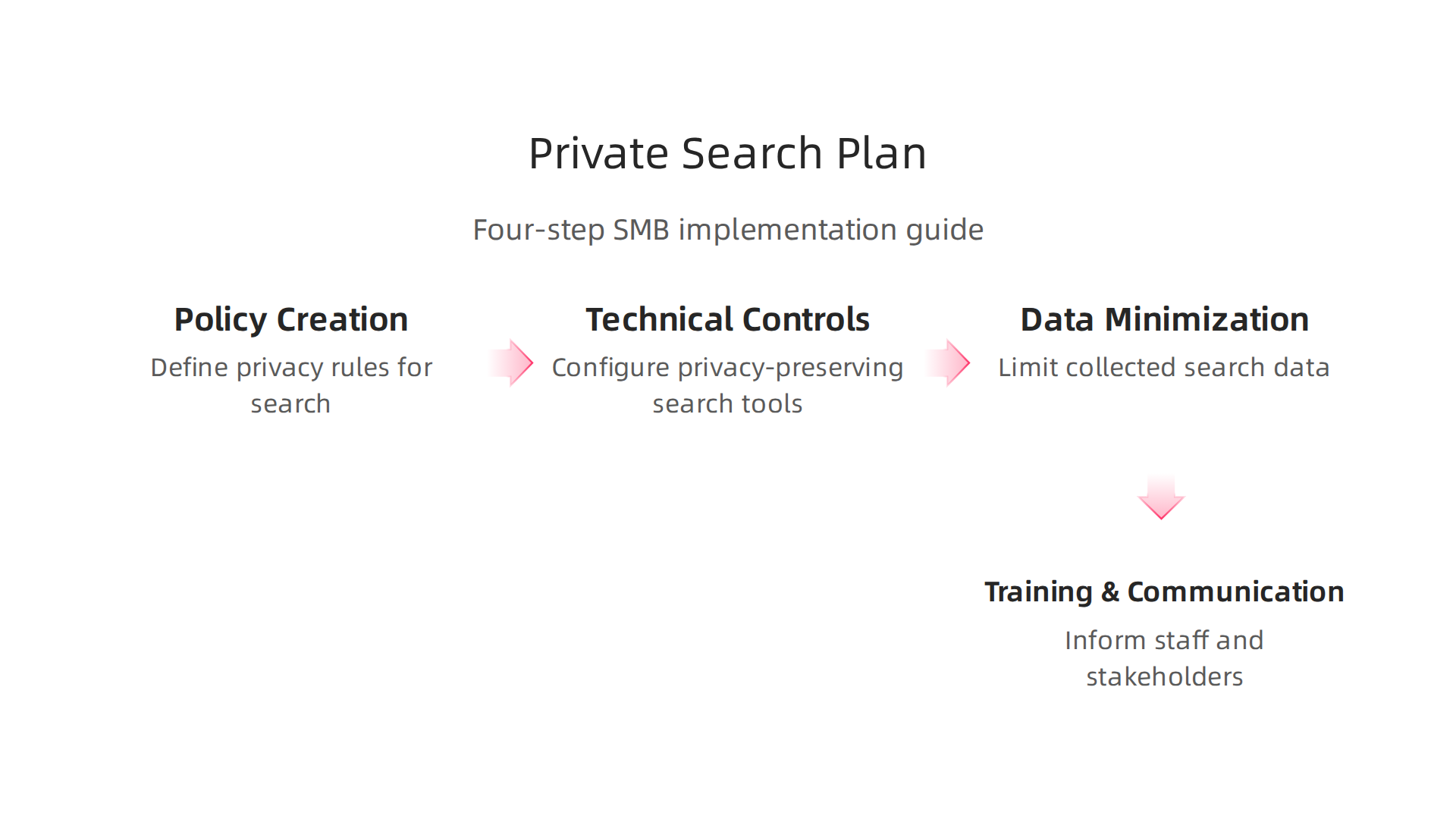
Step 1: Create Internal Guidelines and Policy
Start by making it official. Create a simple, clear guideline for your team. Explain when and why to use the chosen private search engine.
Your policy could state:
- For all general web research and competitive analysis, use our company’s designated private search engine.
- When checking our own website’s search rankings, use the private engine to get an unbiased, user-level view.
- Recognize that some specialized tools (like certain industry databases) may require their own search. That’s okay. The goal is to make the default search engine on all work browsers a private one.
This is also the perfect time to review your own website’s privacy policy. Showing you respect user data starts with being transparent about your own practices. You can use a free small business privacy policy template from Termly or another reputable generator like iubenda to ensure you clearly communicate how you handle visitor information.
Step 2: Roll It Out Technically Across Devices
Now, make the switch easy for everyone. Manually changing settings on every computer and phone is a hassle.
Instead, provide clear instructions or, if you have IT support, configure settings centrally. Show your team how to:
- Set the new private search engine (like DuckDuckGo Search Engine or Brave Search) as the default in Chrome, Firefox, Safari, or Edge.
- Install browser extensions that enhance privacy, if your chosen engine recommends them.
- Change the search engine on their mobile devices for work-related browsing.
Providing a one-page guide or a quick 5-minute demo can remove friction and encourage adoption.
Step 3: Shift Your Marketing Analytics Mindset
This is a big shift for many marketers. With more visitors using private search engines, you’ll see less individual tracking data in tools like Google Analytics. That’s not a loss. It’s a prompt to focus on better metrics.
Move your focus to aggregate data that still provides powerful insights:
- Overall Traffic Trends: Are your visits from search engines going up or down?
- Engagement Metrics: Are people reading your pages, watching your videos, or spending more time on your site?
- Conversion Rates: What percentage of your search visitors become leads or customers?
- Keyword Groups: Instead of tracking individual users, look at the themes and topics that bring people to your site.
This approach values user privacy while still giving you the information you need to grow.
Step 4: Communicate This Value to Your Customers
Your privacy commitment is a powerful trust signal. Don’t keep it a secret. Let your customers know you respect their digital space.
You can mention it on your website, in your email newsletter, or on social media. A simple statement like, "Our team uses privacy-respecting search tools because we believe in protecting online data, a value we extend to every customer interaction," builds authenticity.
This commitment starts with a trustworthy online home for your business. A professional, fast, and secure website is the foundation of that trust. Managing this can be complex, but a service like Weblish can handle it for you, building and maintaining a premium website that showcases your quality and respects your visitors. Get started with Weblish by signing up and claiming your free trial to build that solid foundation.
Summary
This article explains why search privacy is a business concern, not just a personal choice, and shows how adopting privacy-first search tools can reduce data leakage, protect competitive intelligence, and build customer trust. It defines private search engines, contrasts them with mainstream engines like Google, and lays out the core privacy principles such as no logging, no profiling, and tracker blocking. The piece also explains the technical approaches these engines use (proxying queries, independent indexes, Tor integration) and offers a side-by-side comparison of trade-offs—better confidentiality versus less personalized local results and feature parity. For marketers it describes how SEO shifts toward authority, relevance, and technical fundamentals when personalization is removed. The article provides a decision framework to evaluate providers and practical four-step rollout guidance for SMBs, and it recommends a hybrid workflow and managed services for teams that need help implementing these changes. After reading, you’ll understand when to use private search, how to choose one, and how to operationalize a privacy-conscious search strategy across your business.