
Choose Your Best UI UX Design Course for Career and Business in 2026
This article explains why choosing the right UI/UX design course matters for both small and mid-sized businesses and career changers in 2026. It describes how p…


Having a good website is super important for small and mid-sized businesses, often called SMBs, and for people looking to change their jobs in 2026. Think of your website as your store window online. If it looks messy or is hard to use, people will just walk away. This means fewer new customers for businesses and missed chances for career changers to show off their skills.
Actually, many businesses lose out on new leads and money because their websites aren’t built in a smart way. When a website is confusing or slow, people get frustrated and leave. This bad web design leads to low lead generation and lost revenue. It’s like having a helpful salesperson who suddenly can’t talk clearly or guide customers. The goal of any business website is to turn visitors into people who are interested in what you offer. Without good design, that just doesn’t happen.
This is where choosing the right ui ux design course becomes a big deal. For SMBs, a solid ui/ux design course can teach you or your team how to make your website much better. You can learn how to create a site that customers love to use, making it easier for them to find what they need and become a lead. This builds up your own skills so you don’t always have to rely on outside help. Or, if you do hire someone, knowing about good UI/UX design helps you pick the best person for the job.
For career changers, taking a course for ui ux can open doors to exciting new jobs. Learning about user interface (UI) and user experience (UX) design is a very valuable skill in today’s digital world. It’s about making sure websites and apps are easy and fun for people to use. A good ux and ui course can give you the knowledge and tools you need to step into this growing field.
But here’s the thing: not all courses are the same. Some online courses have very low completion rates, meaning many people start but don’t finish them. For example, some self-paced courses on big marketplaces might have completion rates below 15%, while live, structured programs see much higher success rates, sometimes even 50% to 80% or more, according to recent data Course Completion Rate Benchmarks: Data & How to …. This shows how important it is to pick a course that truly works for you. Choosing a high-quality ui and ux course means you’ll actually learn the skills and reach your goals, whether that’s improving your business website or starting a new career path.
When your website isn’t bringing in the customers you need, it might be time for a change.
Grow Your Traffic on Autopilot
When you are looking for a good UI/UX design course, it’s really helpful to know what UI and UX actually mean. These two terms sound similar, but they stand for different parts of making a website or app. Think of it like building a house.
What is UI vs. UX – foundational concepts every course should teach
User Interface (UI) is all about how a website or app looks. It’s what you see, like the buttons, text, colors, pictures, and how all these pieces are put together. A good UI makes things easy to read and nice to look at, which is key for turning visitors into customers. Imagine a colorful, clear dashboard that helps people quickly find what they need. This part of design focuses on the visual elements and how you interact with them directly, defining things like interaction sequences and user interface structure. You can learn more about this specific area by understanding what is UI design the simple definition.
User Experience (UX) is about how a person feels when they use a website or app. Is it easy to find what you want? Is it smooth, quick, and helpful? Or is it confusing and frustrating? UX looks at the whole journey a user takes, from the very first click to reaching their goal. A great UX makes people happy and want to come back. An excellent ui ux design course will teach you about these core principles.
So, UI is about the looks, and UX is about the feelings and ease of use. They work hand-in-hand. You can have a beautiful website (great UI) that is impossible to use (bad UX), or a super easy website (great UX) that looks plain (bad UI). For a website or app to truly shine, you need both a strong UI and a smooth UX.
A good ux and ui course will teach you many practical skills to make sure both parts are excellent. These skills include:
- Research: Finding out what people really need and want from a website. This often involves talking to real users.
- Wireframing: Drawing basic outlines or blueprints for a website’s layout, showing where things will go.
- Prototyping: Making simple, clickable versions of the design to test how it works before building the whole thing.
- Visual Design: Choosing the right colors, fonts, and images to make the interface appealing and clear.
- Usability Testing: Watching real people use the website or app to see if they can complete tasks easily and without trouble. You learn to evaluate user interfaces based on established UX/UI principles.
By learning these foundational concepts and skills in a proper ui and ux course, you’ll be able to create websites that not only look good but also provide a great experience for everyone. This helps businesses get more leads and helps career changers find new job opportunities in this growing field. A critical part of good UX is creating trust with your visitors, which you can explore further by learning about designing UX for trust.
To truly understand and build great websites, a strong ui ux design course will guide you through specific learning parts, or modules. These modules are often set up in a way that builds your knowledge step-by-step, helping you learn how to make websites and apps that people love to use.
Core curriculum topics: modules, timelines, and must-have projects
A good ui/ux design course usually starts with the basics and then moves to more complex ideas. Think of it like learning to build with LEGOs: first you learn about the different bricks, then how to put them together, and finally how to make something amazing.
Here are the main parts you will likely find in a top-notch course for ui ux:
- User Research: This is where you learn how to find out what real people need and want. You might learn how to ask questions, watch how people use things, or even run surveys. The goal is to deeply understand the users before you design anything. Many courses cover this early on to help you design and evaluate interactive software based on real needs.
- Information Architecture: Once you know what users need, you learn how to organize all the content on a website or app in a clear, easy-to-find way. This is like creating a map or blueprint so users can navigate without getting lost. A good course syllabus will highlight modules on information architecture and navigation methods to make sure you learn this crucial step, as shown in the CSUP UIUX syllabus.
- Interaction Design: This module focuses on how users actually interact with your design. What happens when they click a button? How do forms work? It’s about making every click, tap, and swipe feel natural and smooth. This includes learning to define how users will move through a product and how the interface is built, as outlined in a UI/UX Design Program Syllabus.
- Prototyping and Wireframing: Here, you learn to make simple, clickable models of your design ideas. Wireframes are like rough sketches, and prototypes are more detailed versions that you can actually test. Tools like Figma are often taught to help you create these, as noted in the Entri UI/UX syllabus.
- Visual Design: This is where you bring your designs to life with colors, fonts, images, and other visual elements. You learn how to make everything look good and make sense.
- Accessibility: A very important part of any modern ux and ui course is learning how to make sure your designs can be used by everyone, including people with disabilities. This means thinking about things like color contrast, keyboard navigation, and screen readers.
- Usability Testing: After building your prototypes, you learn how to test them with real people to see if they can use the design easily. This helps you find problems and fix them before the product is fully built. You learn to evaluate designs against user requirements.
Most ui and ux course programs are structured over several weeks or months. Each module will have lessons, homework, and hands-on exercises. The order of these modules is important. For example, you usually learn user research before you start designing, so you know who you are designing for.
Must-Have Projects for Your Portfolio
A great ui ux design course won’t just teach you concepts; it will make you build things. You need projects to show what you can do. These "must-have" projects are key for your portfolio, which is like a visual resume that shows off your skills to future employers.
Look for a course that includes:
- Real-world problems: Projects that challenge you to solve actual user problems.
- Multiple stages: Projects where you go through all the steps: research, wireframing, prototyping, testing, and making final visual designs.
- Feedback: Opportunities to get expert feedback on your work so you can improve.
Building a strong portfolio with practical projects is one of the best ways to show you are ready for a new job in UI/UX design. If you’re wondering how to make your portfolio stand out, consider checking out this guide on how to build a portfolio UI UX designer that wins clients in 2026. A detailed UI/UX Design Course Syllabus Overview will usually list the types of projects you’ll work on.
To make sure you pick the best online ui ux course that gives you these valuable projects and skills, keep reading!
Now that you know what a good ui ux design course teaches, let’s look at how these courses are offered. It’s like choosing how you want to learn to ride a bike: maybe you learn on your own, with a friend, in a special class, or even go to a school for it. The best ui/ux design course for you will depend on your needs, how much time you have, and how you like to learn.
Let’s compare the different kinds of ui and ux courses you can find in 2026:
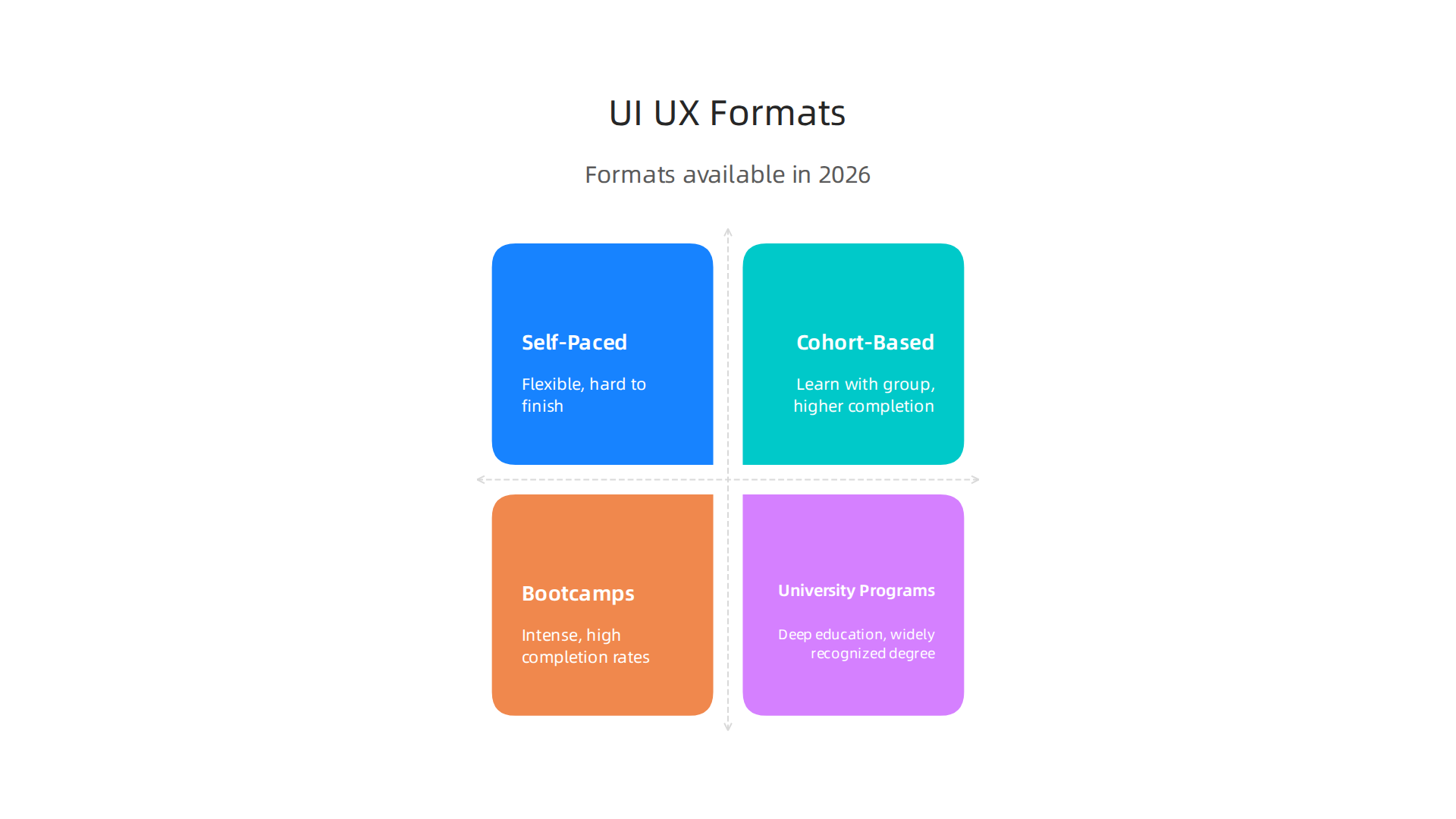
Self-Paced Courses
These courses let you learn on your own schedule. You get all the lessons and materials at once, and you can work through them whenever you want.
- Strengths: They are very flexible, which is great if you have a job or other duties. They often cost less money, too.
- Trade-offs: It can be hard to finish these courses. Studies show that many people who start self-paced courses don’t finish them, with completion rates sometimes as low as 5 to 15 percent for free options and around 30 to 40 percent for paid ones. This is because there’s no one pushing you to keep going. A helpful report found that only about 5 to 15% of students complete self-paced online courses, which is much lower than traditional classrooms Why most self-paced courses fail.
- Mentorship/Peer Learning: Usually, there isn’t much personal help from teachers or chances to learn with other students.
Cohort-Based Courses
These courses involve learning with a group of students at the same time. You often have live classes, homework deadlines, and a set schedule.
- Strengths: You get to learn with others, which means you can ask questions and share ideas. Having deadlines and a teacher helps you stay on track. This type of course has much higher completion rates, often 40 to 70 percent, because of the group effort and guidance. Some live cohort programs see 60 to 70 percent completion, much higher than self-paced options Self-Paced vs Live Cohort Coding Courses.
- Trade-offs: They are less flexible because you have to follow a set schedule. They can also cost more than self-paced options.
- Mentorship/Peer Learning: These courses usually offer more support from teachers and good chances to work with classmates.
Immersive Bootcamps
Bootcamps are very intense, short-term programs that teach you a lot in a little time. They are often full-time and focus on getting you ready for a job.
- Strengths: They are known for their high completion rates, often 60 to 80 percent or even higher, because they are so focused and demanding. You get a lot of hands-on projects and direct help from experts. Many also help you find a job after you finish. A report on online learning platforms compared various options, noting bootcamp programs have completion rates of 75 to 90 percent Online Learning Platforms Compared.
- Trade-offs: Bootcamps are usually very expensive and require a lot of your time each day. They can be very challenging.
- Mentorship/Peer Learning: Strong mentorship and peer learning are common in bootcamps, which means you’ll have lots of support and chances to collaborate. You can learn more about finding the right online learning platforms for web design and how they can boost lead generation for small businesses.
University Programs (Degrees)
This means getting a formal degree, like a Bachelor’s or Master’s, from a college or university.
- Strengths: These programs offer a very deep and broad education. A degree from a university is widely recognized by employers and can open many doors.
- Trade-offs: They are the longest option, often taking years to complete, and they are usually the most expensive.
- Mentorship/Peer Learning: You’ll have access to professors and classmates, but the support might not be as personal as in a small bootcamp. If you’re wondering about the value of such a degree, you might find this guide on whether a UX designer degree is worth it helpful.
When picking a ui ux design course, think about what works best for you.

Do you need a lot of flexibility, or do you prefer a strict schedule with a group? How much time and money can you put into it? Each type of course has its own good points and things to consider.
After learning UI/UX design, you’ll be ready to create websites and apps that not only look great but also work well for users, helping businesses get more customers. If you’re a small or mid-sized business owner looking to improve your online presence and turn your website into a lead-generating machine, consider connecting with a service that understands growth. You can Grow Your Traffic on Autopilot.Now that you know what a good ui ux design course teaches, let’s look at how these courses are offered. It’s like choosing how you want to learn to ride a bike: maybe you learn on your own, with a friend, in a special class, or even go to a school for it. The best ui/ux design course for you will depend on your needs, how much time you have, and how you like to learn.
Let’s compare the different kinds of ui and ux courses you can find in 2026:
Self-Paced Courses
These courses let you learn on your own schedule. You get all the lessons and materials at once, and you can work through them whenever you want.
- Strengths: They are very flexible, which is great if you have a job or other duties. They often cost less money, too.
- Trade-offs: It can be hard to finish these courses. Studies show that many people who start self-paced courses don’t finish them, with completion rates sometimes as low as 5 to 15 percent for free options and around 30 to 40 percent for paid ones. This is because there’s no one pushing you to keep going. A helpful report found that only about 5 to 15% of students complete Why most self-paced courses fail, which is much lower than traditional classrooms.
- Mentorship/Peer Learning: Usually, there isn’t much personal help from teachers or chances to learn with other students.
Cohort-Based Courses
These courses involve learning with a group of students at the same time. You often have live classes, homework deadlines, and a teacher.
- Strengths: You get to learn with others, which means you can ask questions and share ideas. Having deadlines and a teacher helps you stay on track. This type of course has much higher completion rates, often 40 to 70 percent, because of the group effort and guidance. Some live cohort programs see 60 to 70 percent completion, much higher than self-paced options, according to a comparison of Self-Paced vs Live Cohort Coding Courses.
- Trade-offs: They are less flexible because you have to follow a set schedule. They can also cost more than self-paced options.
- Mentorship/Peer Learning: These courses usually offer more support from teachers and good chances to work with classmates.
Immersive Bootcamps
Bootcamps are very intense, short-term programs that teach you a lot in a little time. They are often full-time and focus on getting you ready for a job.
- Strengths: They are known for their high completion rates, often 60 to 80 percent or even higher, because they are so focused and demanding. You get a lot of hands-on projects and direct help from experts. Many also help you find a job after you finish. A report on Online Learning Platforms Compared noted bootcamp programs have completion rates of 75 to 90 percent.
- Trade-offs: Bootcamps are usually very expensive and require a lot of your time each day. They can be very challenging.
- Mentorship/Peer Learning: Strong mentorship and peer learning are common in bootcamps, which means you’ll have lots of support and chances to collaborate. You can learn more about finding the right online learning platforms for web design and how they can boost lead generation for small businesses.
University Programs (Degrees)
This means getting a formal degree, like a Bachelor’s or Master’s, from a college or university.
- Strengths: These programs offer a very deep and broad education. A degree from a university is widely recognized by employers and can open many doors.
- Trade-offs: They are the longest option, often taking years to complete, and they are usually the most expensive.
- Mentorship/Peer Learning: You’ll have access to professors and classmates, but the support might not be as personal as in a small bootcamp. If you’re wondering about the value of such a degree, you might find this guide on is a UX designer degree worth it helpful.
When picking a ui ux design course, think about what works best for you. Do you need a lot of flexibility, or do you prefer a strict schedule with a group? How much time and money can you put into it? Each type of course has its own good points and things to consider.
After learning UI/UX design, you’ll be ready to create websites and apps that not only look great but also work well for users, helping businesses get more customers. If you’re a small or mid-sized business owner looking to improve your online presence and turn your website into a lead-generating machine, consider connecting with a service that understands growth. You can Grow Your Traffic on Autopilot.
After looking at all the different types of UI/UX design courses, from self-paced lessons to full university degrees, the next important step is to make sure the course you pick is truly good. It’s not just about the format; it’s about the quality of what you learn and who teaches you. A good ui ux design course will prepare you well for a job in 2026, helping you create user-friendly designs that boost business growth.
Here’s how to check the quality of any ui and ux course:
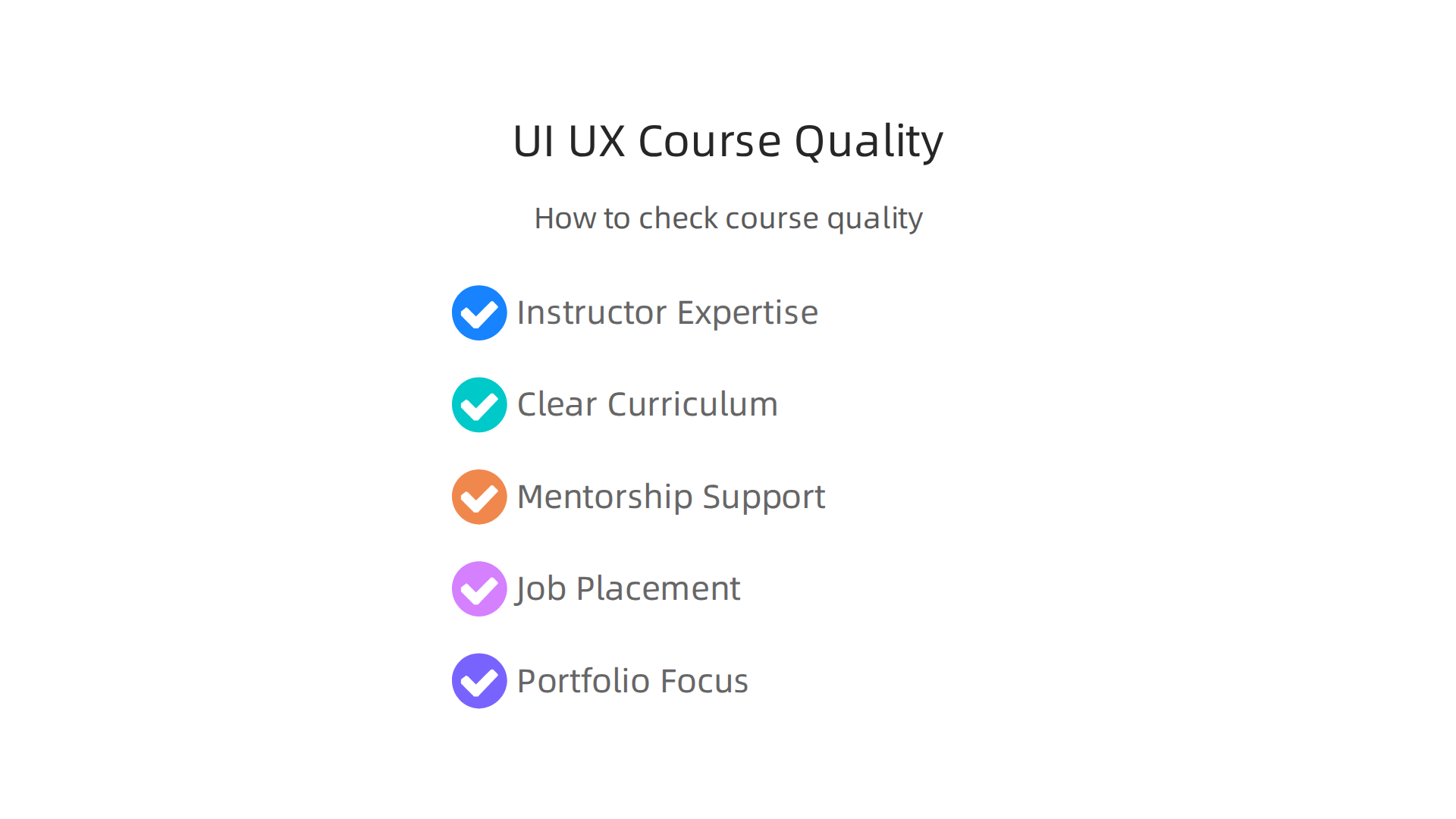
Instructor Expertise
The people teaching your ux and ui course are super important. You want to learn from experts who really know their stuff. Look for instructors who:
- Have real-world experience: Do they work in UI/UX design right now, or have they in the past? They should have worked on actual projects.
- Are good teachers: Just because someone is good at design doesn’t mean they are good at teaching. Look for courses where teachers explain things simply and help you understand.
- Have good reviews: Check what past students say about them. Did students find their teaching helpful and clear?
Clear Curriculum and Assessments
A good ui ux design course will be clear about what you’ll learn and how your progress will be checked.
- Published Syllabus: Can you see a detailed plan of what each week or module will cover? This is like a map for your learning journey. It should show you all the topics and skills you’ll pick up.
- How You’re Graded: How will the course check if you’re learning? Will you have small quizzes, bigger projects, or both? Good courses use different ways to see what you’ve learned, not just tests. These ways of checking should help you grow. As a general guide, good course design greatly helps students finish their studies successfully, as highlighted in studies on Design Elements in Blended Learning Courses.
Mentorship and Support Systems
Learning can be tough, so having help is key.
- Personalized Help: Does the ui/ux design course offer one-on-one time with teachers or mentors? This means you can ask specific questions about your work and get tailored advice.
- Community Learning: Will you get to work with other students? Learning from your classmates and sharing ideas can be very helpful. A strong learning community can make a big difference.
- Career Support: For many, the goal of taking a ui ux design course is to get a job. Does the course help you with your resume, portfolio, or job interviews? This kind of help can be very valuable.
Vetting Job Placement and Industry Project Claims
Many courses promise to help you get a job or work on "real" projects. Here’s how to check if these claims are true:
- Look for Proof: If a course says many students get jobs, ask for numbers. How many students finished the course, and how many found jobs in UI/UX design within a certain time, like six months? Look for specific job titles and salaries.
- Understand "Industry Projects": What does "industry project" really mean? Is it a project for a real company, or is it a made-up project that feels real? While practice projects are good, real client work is even better for your portfolio.
- Portfolio Focus: A strong portfolio is how you show off your skills to future employers. A good ui and ux course will teach you how to build a portfolio that highlights your problem-solving process and measurable results. Employers in 2026 want to see clear problem-solving and impact in your portfolio projects, not just pretty pictures, according to a UX Portfolio Guide. If you want to learn more about how to create a winning showcase of your work, check out our guide on how to build a portfolio ui ux designer that wins clients in 2026.
By looking closely at these points, you can pick a high-quality ui ux design course that will truly help you reach your goals in 2026.
Career outcomes & ROI: what graduates actually achieve after completing courses
After you finish a good UI/UX design course, you’ll want to know what kind of job you can get.

Most people take a course like this to find new work, get a better job, or even start their own freelance business. Let’s look at what usually happens after you complete a ui ux design course.
Getting a Job in UI/UX Design
Many people who finish a ui ux design course aim for a new job. In 2026, there are jobs for UI/UX designers, though the market can be very competitive, especially for new designers. Employers are always looking for people who can really solve problems and make things easy for users.
- Job Titles You Might Get: You could become a UX designer, UI designer, user researcher, or even a product designer. Some graduates also move into roles like content design, UX writing, or even different types of analyst jobs where they use their new UX thinking skills, according to a UK UX Careers Report.
- Job Placement Rates: Some courses share numbers about how many students get jobs after finishing. For example, some programs report that a good number of their students find program-related jobs within a certain time frame. One report mentioned that 67% of those in training related jobs found employment in relevant positions, like web designers, while another program noted that 59% of their alumni secured jobs in UI/UX design after their course completion, as shown in various Employment Outcomes data and an alumni outcome report.
What About Salaries?
Money matters, right? The salary you can earn after a ui ux design course can be quite good, but it depends on many things like where you live and your experience.
- Average Salaries in 2026: For someone just starting out in UX design in the US, you might expect to earn around $96,500 a year, while the median base salary for UX designers across many postings is about $116,500, according to recent reports. For entry-level positions, the US leads globally with salaries around $110,000, as noted in the UX designer salary in 2026 information and the 2026 UX Salary Report.
- Growing Your Salary: As you gain more experience, your salary will likely go up. Senior designers earn much more than junior ones. Some studies show that mid-level designers might earn $95,000 to $135,000, and senior designers $130,000 to $180,000, according to insights on the Viability of UX Design Careers in 2026.
Freelance Work and Internal Changes
Beyond getting a new job at a company, a good ux and ui course can also help you in other ways:
- Becoming a Freelancer: Many UI/UX designers work for themselves, taking on projects for different clients. This gives you flexibility and control over your work.
- Changing Roles at Your Current Job: If you already have a job, learning UI/UX skills can help you move into a new, more design-focused role within your company. This is called an internal role change and can lead to more interesting work and a better salary.
What Employers Look For
No matter what path you choose, employers in 2026 will look closely at your practical skills and your portfolio.
- Your Portfolio is Key: This is your personal showcase of all the projects you’ve worked on. It’s how you show what you can do. Employers want to see how you think, solve problems, and what results your designs achieved. If you want to learn more, our guide on how to build a UI UX designer portfolio that wins clients in 2026 can help.
- Practical Skills: Knowing how to use design tools and methods is very important. But also, showing you can work in a team, talk about your ideas clearly, and understand what users really need are big pluses.
- Demand for Skills: There’s still a good demand for skilled UX designers. In 2026, there are over 214,900 US jobs in digital design, with a 7% growth predicted, as stated in UX Designer Career Statistics.
A strong ui/ux design course won’t just teach you the basics. It should help you build a portfolio and give you the confidence to talk about your work in a way that truly helps you get hired or find clients.
Want to learn more about UI/UX design jobs and salaries? Check out our article on UI UX Designer Jobs 2026: Salary Benchmarks and Hiring Tips for SMBs.
If you’re a small business owner aiming to turn your website into a lead-generating machine, consider connecting with Weblish. You can Grow Your Traffic on Autopilot and see how AI can help your online presence.
Building a strong portfolio is one of the most important parts of any UI/UX design course. This is because employers and clients want to see what you can actually do. A good UI/UX design course will make sure you get plenty of chances to work on projects that showcase your skills. It’s all about building work you can proudly show off.
High-Impact Projects in Your Course
The best way to learn UI/UX design is by doing it. So, a great course will have many hands-on projects. You will create different kinds of work, such as:
- End-to-End Case Studies: These are like full stories of a design problem you solved. You start by finding a problem, doing research, making designs, and then testing them. This shows you can handle a whole project from beginning to end.
- Research Reports: You might do projects focused only on understanding users. This means you learn how to ask the right questions, gather information, and explain what users really need.
- Prototypes: These are working models of a design, often made with tools like Figma. They let others click through your design as if it were a real app or website. This helps show how your ideas would actually work.
- Usability Test Reports: After you design something, you need to test it with real people. These reports show how you ran the tests, what problems users faced, and how you would make the design better.
Many UI/UX courses include lessons on important tools like Figma for creating these designs and prototypes, as mentioned in various UI UX Course Syllabus documents. They also teach you how to evaluate designs based on user needs, a key skill for any designer, according to the CPUX-F Curriculum.
Creating a Portfolio That Gets Noticed
Your portfolio is where you put all your best projects. It’s not just a collection of pretty pictures. It’s a story of how you solve problems. When someone looks at your portfolio, they want to understand your thinking. Experts say that hiring managers look for things like whether you understood the problem, if you made real decisions, and if your work actually made a difference, according to The UX Portfolio Guide (2026).
Here’s how to make your portfolio stand out:
- Start with the Problem: Clearly explain the challenge you were trying to fix. What was the user’s pain point? What was the business goal? This shows you think about the bigger picture.
- Show Your Process: Don’t just show the final design. Walk people through how you got there. What research did you do? What choices did you make along the way and why? A good portfolio shares your approach, process, and what you learned, as detailed in the UX Portfolio Guide: Structure & Strategy to Get Hired (2026).
- Highlight Your Role: If you worked in a team, explain exactly what you did. What were your specific tasks and decisions?
- Show the Impact and Metrics: This is very important. Did your design make things better? Did a website get more visitors? Did users complete tasks faster? Use numbers and real examples to show how your work helped. Employers want to see business outcomes and changes in user behavior, such as increased revenue or lower support tickets, according to a guide on How to Build a UX Portfolio That Actually Gets You Hired (2026).
Many people find that building a strong online presence, including a great portfolio website, helps them attract clients and land jobs. To learn more about how to make your online portfolio work for you, check out tips on Portfolio Website Design That Generates Leads for Small Businesses.
A solid UI and UX course will not only give you the skills to design these projects but also guide you on how to present them effectively in a portfolio. This way, when you finish your training, you’ll have a strong collection of work ready to impress.
A solid UI and UX course will not only give you the skills to design these projects but also guide you on how to present them effectively in a portfolio. This way, when you finish your training, you’ll have a strong collection of work ready to impress.
Pricing, scholarships, and payment options: how to get the best value
Choosing a UI/UX design course is a big step, and understanding the costs is super important.

The price of a UI and UX course can change a lot depending on where you look. Knowing your options for paying can help you pick the best course for ui ux that fits your budget.
Different ways to pay for your UI/UX design course
Most ui ux design courses offer a few main ways to pay:
- One-time payment: Some courses ask for a full payment upfront. For example, a full UI/UX design course might cost around $5,500 to $8,499 if paid all at once, as seen with programs like Designlab’s UX Academy, according to "The 14 Best UX Design Courses for 2026" from Designlab’s blog. Other courses might be around £1,500 in the UK, with a smaller deposit to start, notes UX Academy.
- Monthly subscriptions: Other courses, especially online ones, let you pay a smaller amount each month. For instance, the Google UX Certificate might cost about $49 each month, as highlighted in "Best UX Design Courses: Zero to Portfolio (2026)". This can be a good way to spread out the cost over time.
- Payment plans or installments: Many schools let you divide the total cost into smaller payments over several months. You might pay a deposit, then make monthly payments. Some places offer zero-interest payment plans. For example, some programs let you pay in six or ten monthly parts, or in four monthly installments for a total tuition, as mentioned in articles about UX Academy and other programs. In places like India, you might find EMI options available for your ui ux design course.
Keep an eye out for discounts, too. Some courses offer small savings, like $25 or $200 off, and even $500 for those who finish a beginner course first, according to Designlab’s payment plans.
Finding help to pay for your course
Don’t let the price tag scare you. Many options can help you afford a good ux and ui course:
- Scholarships: A lot of schools offer scholarships. These are like gifts of money that you don’t have to pay back. They are often given to students who meet certain needs or show promise. You might find scholarships that give you a percentage off the total course price, such as 30% off, as mentioned by UX Academy. Make sure to ask if the ui and ux course you are interested in has scholarship options. To find out more about how these scholarships can help, you can explore the Odenza Marketing Group scholarship eligibility.
- Deferred payments: Some programs might let you start the course and pay later, perhaps after you get a job. This is less common but worth asking about if it’s a concern.
- Employer reimbursement: If you’re already working, your company might be willing to pay for your ui ux design course. Many employers see this as an investment in their staff’s skills. It’s always a good idea to ask your manager or HR department if they have such programs.
By looking into these different payment and support options, you can find a ui ux design course that gives you great value for your money and helps you start a new career without breaking the bank.
Are you ready to turn your learning into real-world impact and grow your business? Grow Your Traffic on Autopilot.
Summary
This article explains why choosing the right UI/UX design course matters for both small and mid-sized businesses and career changers in 2026. It describes how poor website design harms lead generation and shows how UI and UX skills can fix that by improving usability, trust, and conversions. The guide breaks down the difference between UI (visual interface) and UX (user journey), lists core curriculum modules like research, wireframing, prototyping, accessibility, and usability testing, and highlights the practical projects you should build for a portfolio. It compares course formats—self-paced, cohort-based, bootcamps, and university programs—showing trade-offs in cost, flexibility, and completion rates. The article gives clear advice on vetting instructors, assessing job-placement claims, and choosing payment options and scholarships. Finally, it outlines typical career outcomes and salary expectations so readers can judge ROI and pick the course that best meets business or career goals.