
SEO Content Optimization Strategies That Work for Small Businesses in 2026
This article explains practical SEO content optimization for small and mid-sized businesses in 2026, showing how to turn a static website into a lead-generating…


Introduction
You spent good money on a beautiful website. It looks professional. It loads fast. But somehow, the leads are not coming in.

You are not alone. Many small business owners focus on web design and forget about what happens after the site goes live. They leave valuable traffic sitting on the table.
Here is the thing. In 2026, website, blog, and SEO together make up the number one ROI-generating channel cited by marketers according to SEO Stats That Are Hard to Ignore.

And small businesses are 23 percent more likely than average to see ROI from blog content. That means understanding search engine marketing for small businesses is not optional anymore. It is essential.
What is SEO content optimization?
In simple terms, it means making every page on your website match what people are actually searching for.
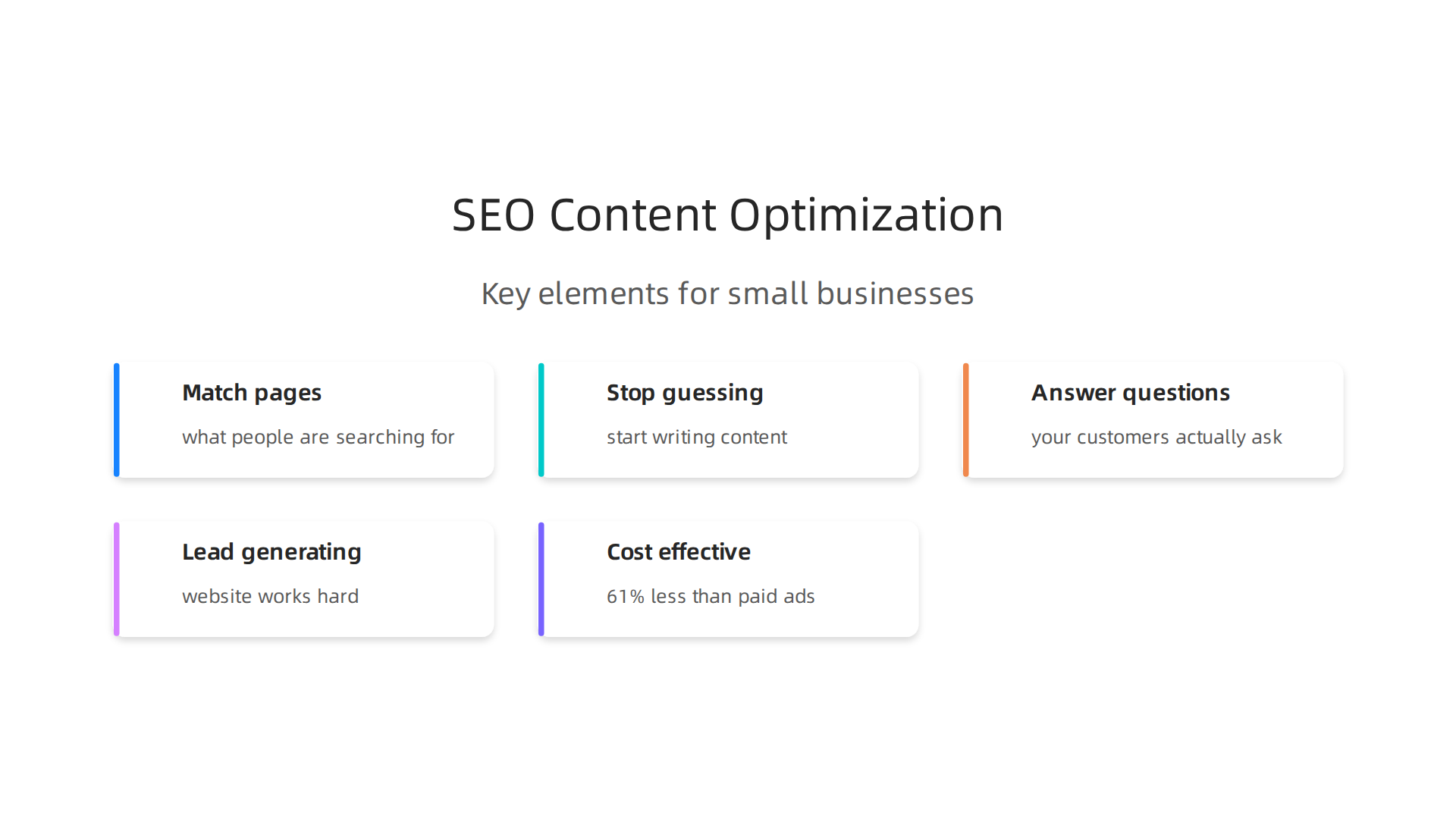
You stop guessing. You start writing and structuring content that answers real questions your customers ask.
When you do this right, your website stops being a static brochure. It becomes a lead-generating machine. Every blog post, every service page, and every product description works hard to bring in visitors who are ready to buy.
The best part? You do not need a big budget. Compared to paid ads, organic search leads cost 61 percent less to acquire and close at a rate of 14.6 percent. That is nearly double the conversion rate of most outbound channels.
This guide walks you through actionable strategies that actually work in 2026. We also look at how Weblish uses artificial intelligence to grow your traffic on autopilot so you can focus on running your business.
Grow Your Traffic on Autopilot Connect your website today and let AI handle the content optimization work for you.
Why SEO Content Optimization Matters for SMBs in 2026
You might think SEO is only for big companies with big budgets. But that is not the case. In 2026, search engine optimization is where small and mid-sized businesses can actually beat the big players. Here is why.
The data makes it clear. Organic search still delivers over half of all website traffic. According to SEO market data for 2026, organic search accounts for more than 50 percent of traffic globally. And about 74 percent of SMBs now invest in SEO, as shown in key 2026 SEO figures.
They do this because it works. A solid SEO content optimization strategy brings in visitors who are already looking for what you offer.
But SEO content optimization today is different. It is not about packing a page with keywords. Google’s Helpful Content System wants content that truly helps the reader. You need to match user intent. When someone searches "affordable seo services for small business," they want a clear answer. If your page delivers that, you win.
Here is the best part. Small businesses can compete by going after long-tail keywords. These are specific, low-competition phrases. They make up about 70 percent of all searches. So instead of fighting for "SEO services," you target something like "expert seo services for local law firms." These queries convert better because the searcher knows what they need.
Creating content around these terms builds your authority. Over time, Google sees you as a trusted source in your niche. This leads to higher rankings and more traffic without expensive ads. If you are not sure how to build this authority, working with someone experienced helps. Read this guide on why your small business needs an SEO consultant in 2026 for step-by-step advice.
So why does SEO content optimization matter? It gives you a predictable, cost-effective way to attract customers. And with AI tools like Weblish handling the research and writing, you can scale your efforts without hiring a full team. The result is a website that works for you round the clock.
Next, let us look at the actual ranking factors that will decide your success in 2026 and how to prioritize them.
Core Components of a Winning SEO Content Strategy
So what does a strong SEO content strategy actually look like in practice? It is not a one-time task. It is a system that covers research, structure, and ongoing fine-tuning.
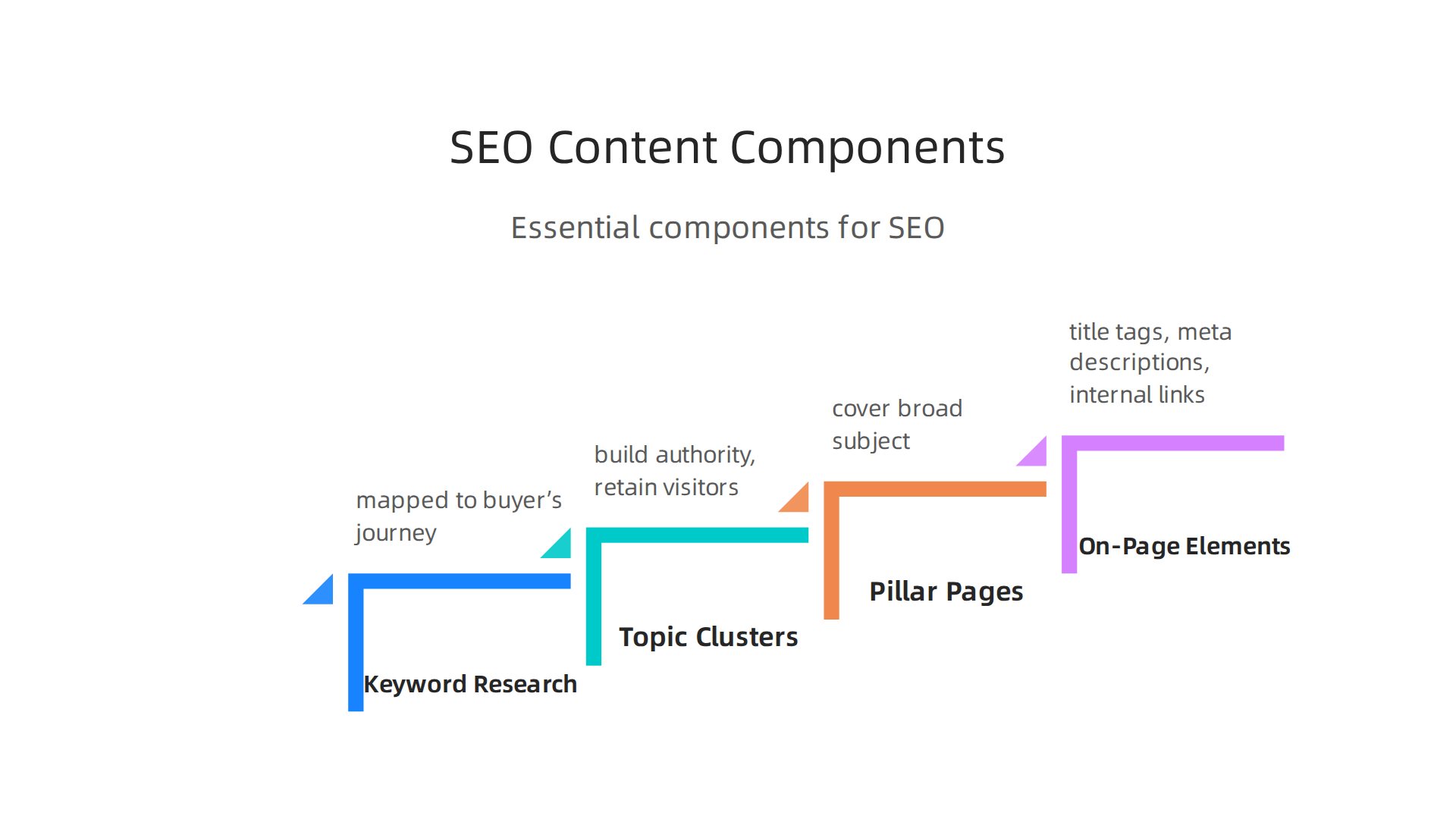
Keyword Research Mapped to the Buyer’s Journey
Start by understanding what your ideal customer searches for at each stage. Someone who just discovered a problem searches differently than someone ready to buy. Map keywords to these stages. For the awareness stage, target broad questions. For decision stage, use terms like "affordable seo services" or "expert seo services." This approach brings in the right people at the right time.
Topic Clusters and Pillar Pages
Google rewards websites that show deep knowledge on a topic. Build a pillar page that covers a broad subject, then link to cluster pages that dive into specific subtopics. This structure tells Google you are an authority. It also keeps visitors on your site longer, which boosts ranking signals.
On-Page Elements Need Constant Love
Title tags, meta descriptions, and internal links are not set-and-forget items. They need regular updates as your content grows. Follow a detailed on-page SEO checklist for 2026 to make sure every page is optimized. Pay special attention to internal linking. It spreads authority across your site and guides users naturally.
If you are still figuring out how to structure your SEO content, start with a solid understanding of search engine marketing for small business success. That foundation makes everything else easier.
And here is the best part. You do not have to do all this manually. With the right system, each piece of content gets optimized before it even goes live. Want to Grow Your Traffic on Autopilot? Weblish can handle the research, writing, and optimization for you.
Keyword Research and Topic Clusters
Let’s talk about the actual research phase. You can’t build a strong content strategy without knowing what your audience is actually typing into Google.
Start with tools like Ahrefs, SEMrush, or Google Keyword Planner. These platforms help you find high-intent keywords with low competition.

That means terms people are actively searching for, but not many sites are fighting over. Those are your gold mines.
Here is a key shift for 2026. Instead of chasing single keywords, group related terms around a pillar page. This is called a topic cluster. When you link all your supporting posts back to one main page, Google sees you as a real authority on that subject. Your page authority grows. Your rankings improve.
Long-tail keywords are especially powerful here. When someone searches "how to fix a leaky bathroom sink" instead of just "sink repair," they are much closer to taking action. The intent is crystal clear. The conversion rate is higher. It is a classic win for smart seo content optimization.
For a deeper look at how to approach this step by step, check out this complete guide to on-page SEO for practical tips.
And if you want expert guidance on your strategy, consider working with an SEO consultant for your small business. That outside perspective can save you months of guessing.
Now that you have your keyword research and topic clusters ready, it’s time to optimize the actual pages on your site. This is where on-page SEO and technical optimization come in. These elements make sure search engines understand your content and users actually click on it.
Start with your title tags, meta descriptions, and header tags. These small pieces have a big impact on click-through rates. For example, a good title tag with your target keyword near the front tells both users and Google what your page is about. You can follow a detailed on-page SEO checklist from Semrush to get every detail right.
Next, don’t ignore the technical side. Page speed, mobile responsiveness, and structured data are all ranking factors in 2026. A slow site or one that looks bad on a phone will lose visitors fast. Tools like Google’s PageSpeed Insights can help you find and fix issues.
Finally, run regular content audits. Look for pages that are not performing well. Update them with fresh information, improve the headers, and add better internal links. This keeps your site healthy and shows Google you are keeping content up to date.
If your website needs a refresh, learn how to fix your bored website so it stops losing customers.
Ready to take the next step? Grow Your Traffic on Autopilot with Weblish and let AI handle the heavy lifting.
How to Measure and Improve Content Performance
You have done the hard work of optimizing your pages. But how do you know if it is actually working? That is where measuring content performance comes in. Without data, you are just guessing. With the right metrics, you can see what is driving results and what needs a fix.
Start by tracking a few key numbers. Organic traffic shows how many visitors find you through search engines.
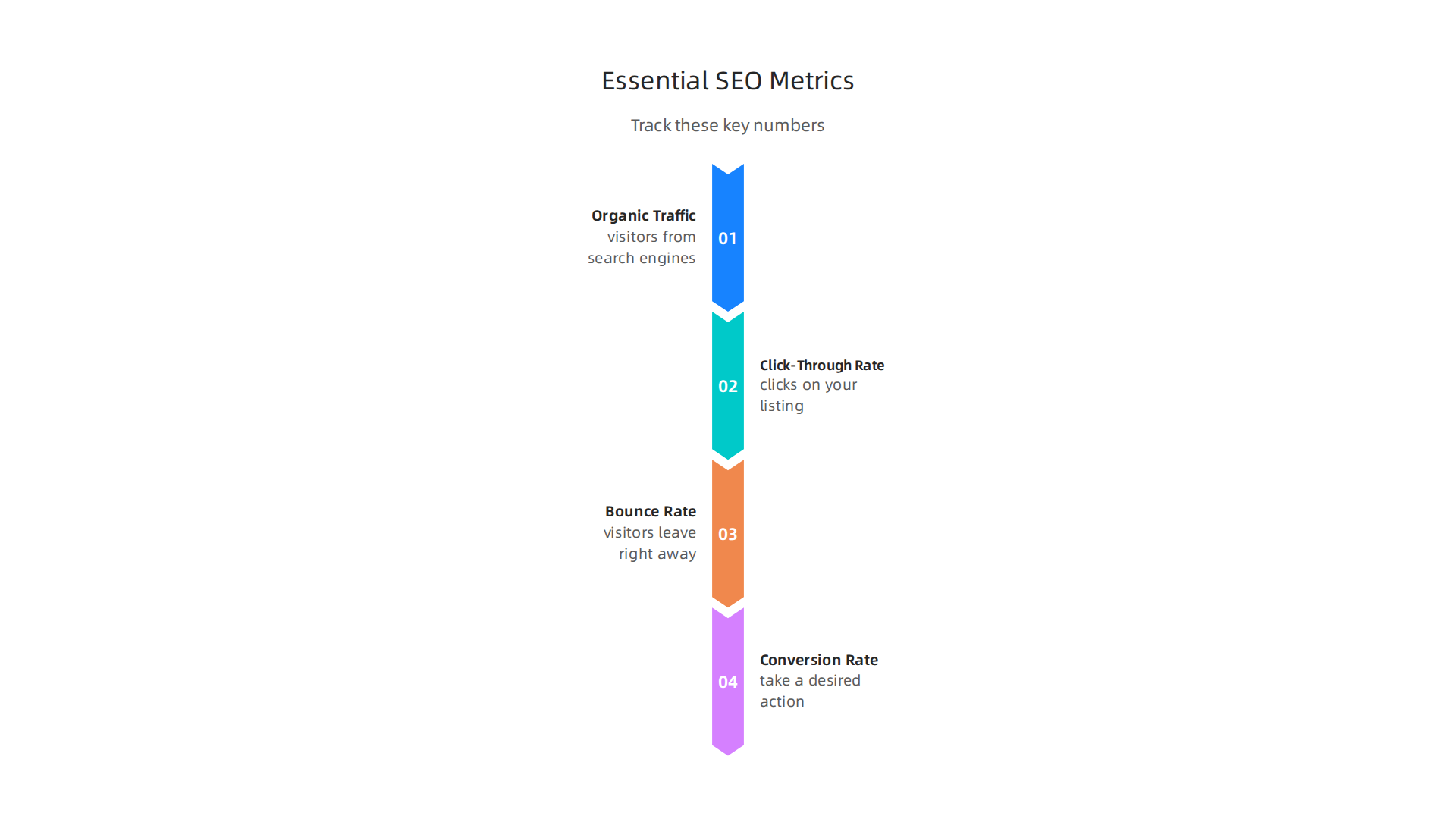
Click-through rate (CTR) tells you how often people click on your listing when they see it. Bounce rate shows if visitors leave right away. And conversion rate tracks whether they take a desired action, like filling out a form or making a purchase. These four metrics give you a clear picture of your content health. For a deeper breakdown, check out 3 Essential SEO Metrics Every Small Business Should Monitor.
The best tools for this job are free and powerful. Google Search Console shows you which keywords bring impressions and clicks. Google Analytics tracks what visitors do once they arrive. Microsoft Clarity adds heat maps and dead click data so you can see exactly where people get stuck. Together, they help you spot content gaps and underperforming pages.
Once you have data, do not stop there. Run simple A/B tests on your headlines, meta descriptions, and even the format of your content. Try a list post instead of a long paragraph. Change a title to include a stronger benefit. Test a meta description that asks a question. Small changes can lift your CTR by 10% or more. Keep testing and keep the winners.
If you want to automate reporting and save time, learn how to use the Google Search Console API to automate your SEO reports. This can free you up to focus on creating better content and running more tests.
Common SEO Content Mistakes SMBs Must Avoid
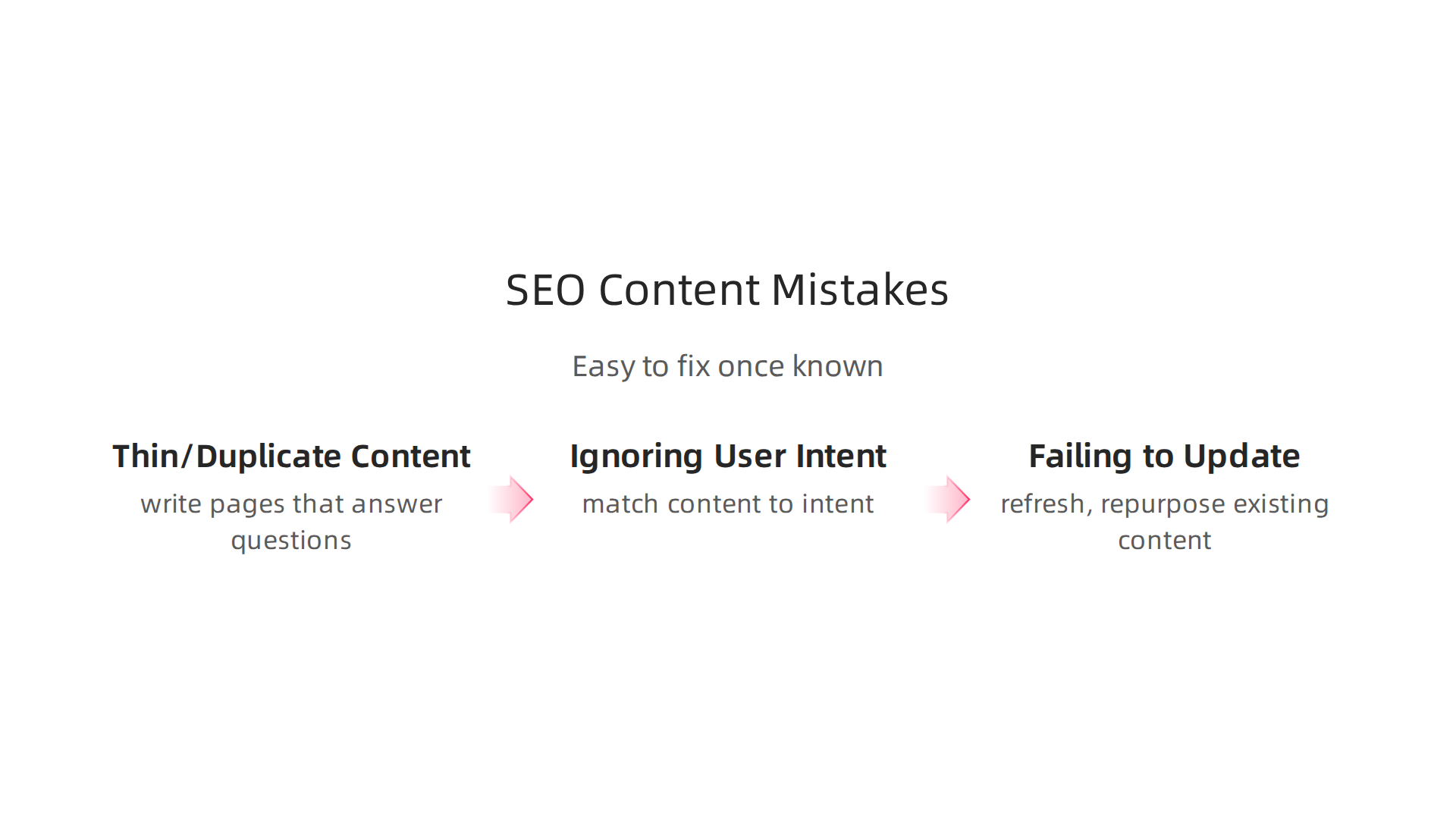
Even after you start measuring performance, your site might still struggle. Why? Because a few common SEO content mistakes quietly hurt your rankings. The good news is they are easy to fix once you know about them.
Mistake 1: Publishing Thin or Duplicate Content
Thin content means pages with very little useful information. A short post that brushes over a topic or a page that copies text from another site confuses search engines. Google wants to show users valuable pages. If your content is thin, your rankings drop.
How to fix it: Write pages that answer real questions. Add examples, tips, and clear explanations. If you must cover similar topics on different pages, make each one unique. Avoid copying and pasting from other sites. According to the Common SEO Mistakes That Hurt Rankings in 2026 guide, short articles that barely answer questions are one of the biggest content quality issues today.
Mistake 2: Ignoring User Intent
User intent is the reason someone searches. Are they looking for information, a specific product, or a local store? If you write a sales page for a keyword that people use to learn something, they will leave quickly. That sends a signal to Google that your page is not helpful.
How to fix it: Before writing, look at the top results for your target keyword. Check if the intent is informational, commercial, navigational, or transactional. Then match your content to that intent. For example, if people search "best SEO services for small business," they want comparisons, not a long tutorial. To learn more about aligning with intent, check out why your small business needs an SEO consultant who can help match content to search goals.
Mistake 3: Failing to Update and Repurpose Existing Content
Many business owners publish content once and then forget it. But old content loses value over time. Statistics become outdated, links break, and new questions go unanswered. That is wasted potential because Google still crawls those pages. If you leave them stale, they slide down in rankings.
How to fix it: Set a schedule to review your top pages every few months. Refresh statistics, add new examples, and update the structure. You can also repurpose an old blog post into a video, a checklist, or a FAQ section. This improves your seo content optimization without starting from scratch.
Turn These Fixes into Growth
Avoiding these mistakes is a big step. But you do not have to do it alone. Tools and services can handle the heavy lifting for you. If you want to stop guessing and start seeing better results, consider a done-for-you solution.
Grow Your Traffic on Autopilot by connecting your website with Weblish. Their team manages SEO, content updates, and optimization so you can focus on running your business.
Future Trends in SEO Content and AI Integration
SEO in 2026 looks very different from just a few years ago. Search engines now use artificial intelligence to answer questions directly. Instead of showing a list of links, Google’s AI Overview appears on most informational searches. If you want your business to stay visible, you need to understand what is coming next.
AI-Powered Content Optimization Tools Are the New Normal
One of the biggest changes is how AI tools help with content creation. Tools like Weblish can automate keyword targeting and generate content briefs. This saves you hours of manual research. The tool suggests the right topics and phrases to include so your content matches what people search for. This is what experts call seo content optimization on autopilot. You no longer need to guess which keywords to use. The AI does the heavy lifting for you.
Voice Search and Featured Snippets Demand Concise Answers
More people now use voice search to ask questions. Think of phrases like "Where is the nearest coffee shop?" or "How do I fix a leaky faucet?" These searches need short, direct answers. Search engines pull these answers into featured snippets and AI summaries. If your content is clear and structured, you have a better chance of being cited. According to the latest 2026 SEO trends and what they mean for your business, Google’s AI Overview appears on 80 to 88 percent of informational queries. That means most people never click a link. They get their answer right on the search page. So your content must work even when no one visits your site.
Personalized Content Experiences Are Now a Ranking Factor
Search engines are getting smarter about who is searching. They look at a user’s history, location, and past behavior. This means the same search can give different results to different people. In 2026, personalized content is becoming a real ranking signal. If your site offers content that feels tailored to each visitor, you will rank higher. That is why businesses need to create content that adapts to user needs. You can automate your SEO reports with the Google Search Console API to track how personalized content performs and make adjustments quickly.
How to Stay Ahead
The future of SEO is all about being clear, helpful, and structured for AI. You do not need to become a technical expert. You just need the right tools and guidance. Many small businesses now choose affordable seo services that combine AI with human strategy. These services handle everything from keyword research to content updates.
If you want to stop worrying about rankings and focus on running your business, consider a done-for-you solution.
Grow Your Traffic on Autopilot by connecting your website with Weblish. Their team uses AI to optimize your content, target the right keywords, and keep you visible as search engines evolve.
Leveraging SEO Analytics Tools for Continuous Optimization
Now that you see where SEO is headed, the next step is to measure how your current content performs. You can’t improve what you don’t track. The good news is that free tools give you all the data you need to start optimizing.
Start with Google Search Console and Google Analytics 4
Every seo content optimization effort begins with a baseline. Google Search Console shows you which keywords bring people to your site. It tells you how many times your pages appear in search results and how often people click. Google Analytics 4 shows what visitors do once they land on your pages. Together, these tools paint a full picture of your traffic and user behavior.
For small businesses, two simple metrics matter most: impressions and user visits. Impressions tell you how visible you are. User visits tell you if your content is compelling enough to keep people around. According to this guide on 3 essential SEO metrics every small business should monitor, tracking dead clicks and heat maps can also reveal where visitors get stuck. If people don’t find what they need, they leave. Fixing those spots improves your conversion rate.
Use AI Tools to Turn Data into Action
Looking at raw data is time consuming. That is why many businesses now use AI powered platforms to automate the analysis. Weblish, for example, connects directly to your Google Search Console and GA4 accounts. It aggregates your key metrics and suggests real time content improvements. Instead of digging through spreadsheets, you get a clear list of which pages need updates and which keywords to target next.
This type of website conversion optimization tools approach lets you act fast. You can focus your energy on writing better content instead of crunching numbers. Many business owners also compare seo services pricing to find affordable options that include analytics reporting. The right tool saves hours each week and keeps you on track.
Build a Monthly Reporting Cycle
Optimization is not a one time task. You need to check your metrics regularly and adjust your strategy. A good habit is to create a monthly reporting dashboard

that tracks organic traffic, top performing pages, and keyword ranking changes. Compare month over month and year over year to spot patterns. Look for which content types generate the most traffic and which pages have the highest conversion rates.
A detailed strategy guide from ReactLL suggests creating a monthly reporting dashboard that tracks organic traffic, top performing pages, and keyword ranking changes. This helps you stay accountable and pivot quickly when something is not working.
If you need expert help interpreting your data, consider working with an SEO consultant. They can help you set up proper tracking and recommend the next best actions. You can learn more in this article about why your small business needs an SEO consultant in 2026.
Continuous optimization is about small, consistent improvements. Use the right tools, review your data monthly, and make changes based on what the numbers tell you. Over time, those small wins add up to real traffic growth.
Real-World Examples: SMBs That Transformed Traffic Through Content Optimization
Let’s look at how three small businesses turned content optimization into real results. These stories show that small, steady changes can lead to big wins.
A Local Service Provider Doubled Organic Leads in 6 Months
A plumbing company had blog posts that were three years old. They refreshed each post with current tips, added new internal links to their service pages, and updated the meta descriptions. Within six months, their organic leads doubled. The key was not writing new content. It was fixing what they already had. Many businesses make the mistake of ignoring old content. You can avoid that by reviewing the SEO mistakes that hurt rankings in 2026 and keeping your archives fresh.
An E-Commerce SMB Lifted Average Order Value by 25%
A small online store selling home goods used topic clusters. They grouped related products and wrote comparison guides. When a visitor read "Best Coffee Makers Under $100," the page linked to other budget kitchen items. This strategy boosted average order value by 25%. People found more of what they needed without leaving the site.
A Professional Services Firm Reached Page 1 for a Tough Keyword
A small accounting firm wanted to rank for "small business tax planning." They built one deep pillar page covering deductions, deadlines, software, and common mistakes. This single page became a resource that earned backlinks and climbed to page one of Google in four months.
These examples show you can achieve similar results. If you want help turning your content into a lead engine, you can Grow Your Traffic on Autopilot with Weblish. For more inspiration, check out these real marketing examples for small business that generate leads and revenue.
Summary
This article explains practical SEO content optimization for small and mid-sized businesses in 2026, showing how to turn a static website into a lead-generating asset. It covers why SEO matters now, how to do keyword research mapped to the buyer’s journey, and how to organize content with pillar pages and topic clusters. You’ll learn which on-page and technical elements to prioritize, how to measure performance with simple KPIs, and common content mistakes that kill rankings. The guide also explains how AI tools can automate research and optimization, when to update existing pages, and how to build a repeatable monthly reporting process. Real-world SMB examples illustrate what works, and the piece points to affordable options—consultants or platforms like Weblish—to scale results without a big team.